
Commentary | Sagartirtha Chakraborty, India’s inequality puzzle: What the World Bank’s numbers reveal and conceal
Can a country, where the top 1 per cent own over 40 per cent of its wealth be called one of the world’s most equal? According to the World Bank, yes. The recent World Bank assertion that India is now among the world’s least inequal countries in terms of consumption, appears to be an encouraging claim. But what do such numbers signify? Can India, with its stark socio-economic divides truly count itself among the world’s most egalitarian nations?
Decoding the World Bank’s claims
The World Bank’s April 2025 ‘Poverty and Equity Brief’ makes a bold claim based on the recent Household Consumption Expenditure Survey data that India’s Gini index – the most commonly used measure of inequality – for consumption fell from 28.8 in 2011-12 to 25.5 in 2022-23, making it the fourth ‘most equal’ country globally. This not only places India ahead of the United States, but also makes it more equal than every G-7 and G-20 country.
Poverty vs. Inequality
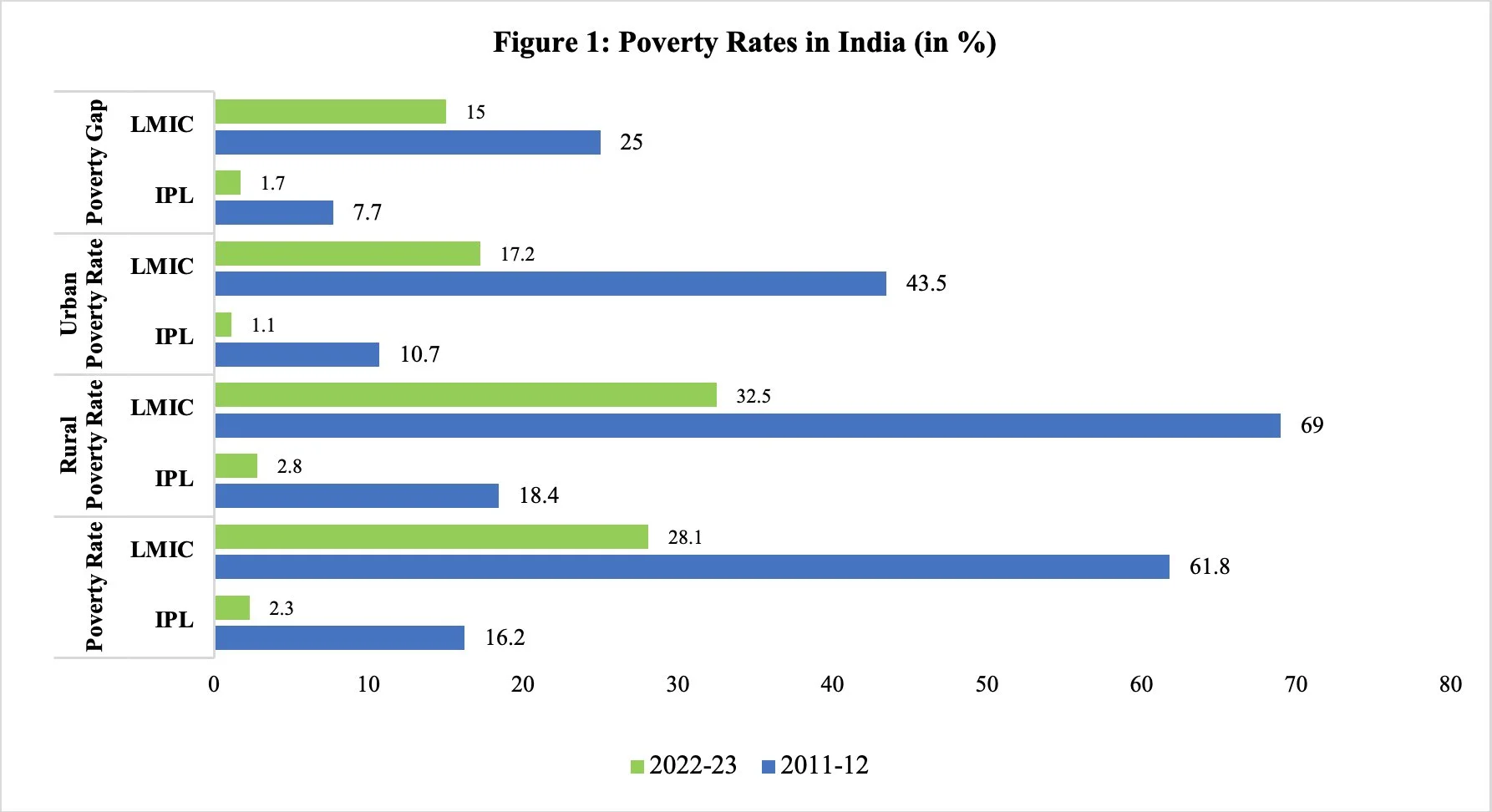
The report highlights that India’s extreme poverty, measured by the $2.15/day international poverty line (IPL), plummeted from 16.2 per cent (2011-12) to just 2.3 per cent (2022-23), pulling about 171 million people out of it. The nation’s rural poverty fell down by 15.6 per cent to 2.8 per cent; while urban poverty declined by 9.6 per cent to 1.1 per cent in a decade. Likewise, poverty under the $3.65/day lower-middle-income category (LMIC) line halved from 61.8 per cent to 28.1 per cent, lifting 378 million people above the threshold (Figure-1).
Source: World Bank
The consumption landscape
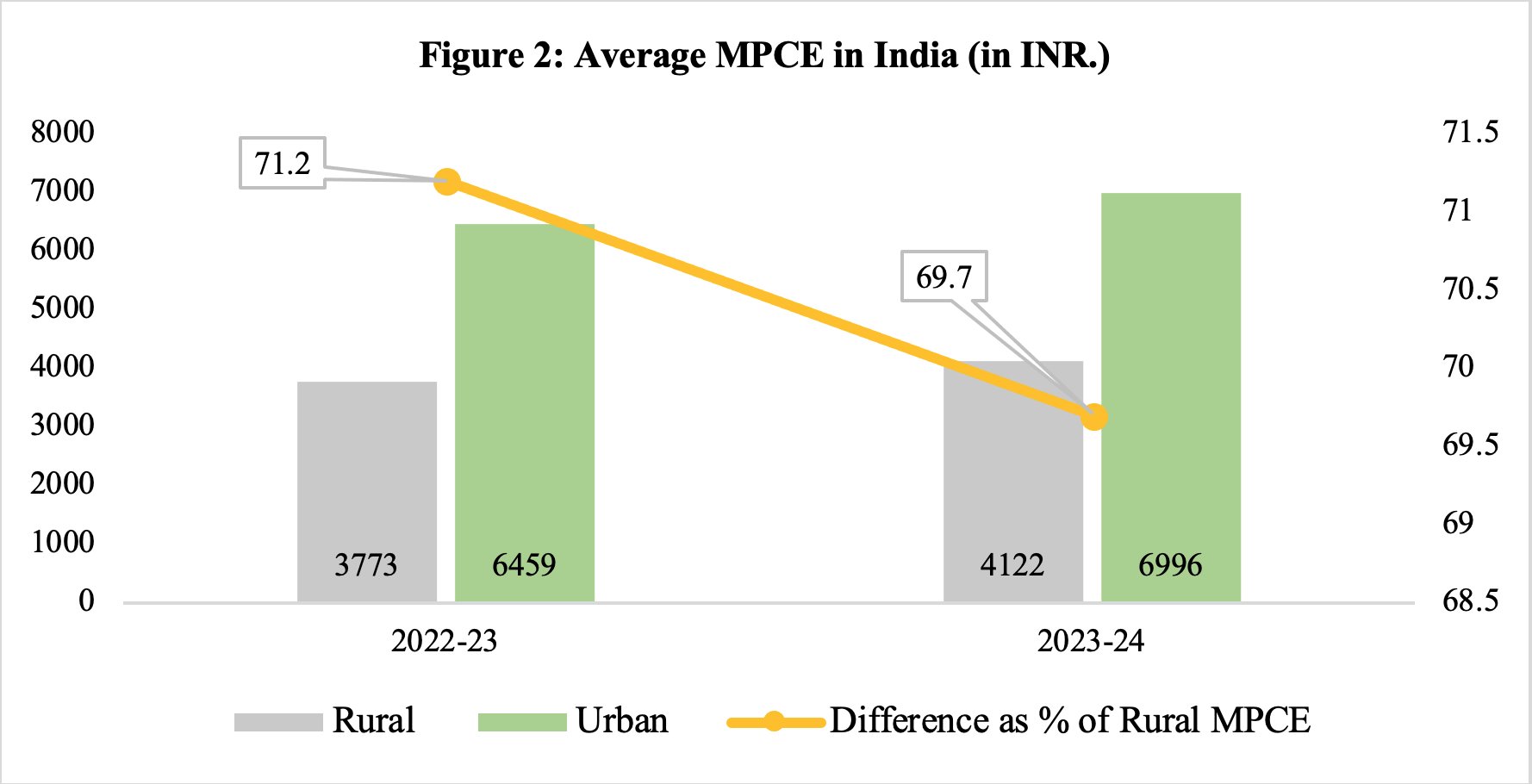
Another striking finding of the report is the narrowing of the rural-urban consumption gap, expressed as a percentage of rural monthly per capita expenditure (MPCE). In 2023-24, the average MPCE stood at INR.4122 in rural areas and INR.6996 in urban areas, which had narrowed from 71.2 per cent in 2011-12 to 69.7 per cent by 2023-24 (Figure-2).
Source: PIB, Government of India
In addition, rural demand rebounded sharply with fast moving consumer goods’ growth in rural areas (6 per cent) outpacing that in urban areas (2.8 per cent) during July-September, 2024. This rural resurgence is reflected in a 9 per cent rise in rural MPCE against 8 per cent growth in urban areas.
Targeted schemes like Ayushman Bharat, PM-KISAN, Stand-Up India, and National Food Security Act (which covers over 800 million people) have fuelled the growth. Under these schemes, over INR.2 trillion is directly transferred to women alone. In fact, the ‘JAM Trinity’ (Jan Dhan accounts, Aadhaar, and Mobile linkage) has slashed leakages, and improved welfare efficiency from 0.32 to 0.91 during 2014-2023. This improved delivery reflects Musgrave’s principle of redistribution. But without structural reforms in taxation and investment, delivery alone cannot address the deep-rooted inequality.
The income-consumption contradiction
Kuznets’ inverted-U hypothesis posits that as economies develop, inequality initially surges before declining – a narrative India may now be stepping into, as reflected by its consumption Gini figures. However, India’s rising income-based Gini from 52 in 2004 to 62 in 2023 tells a different story.
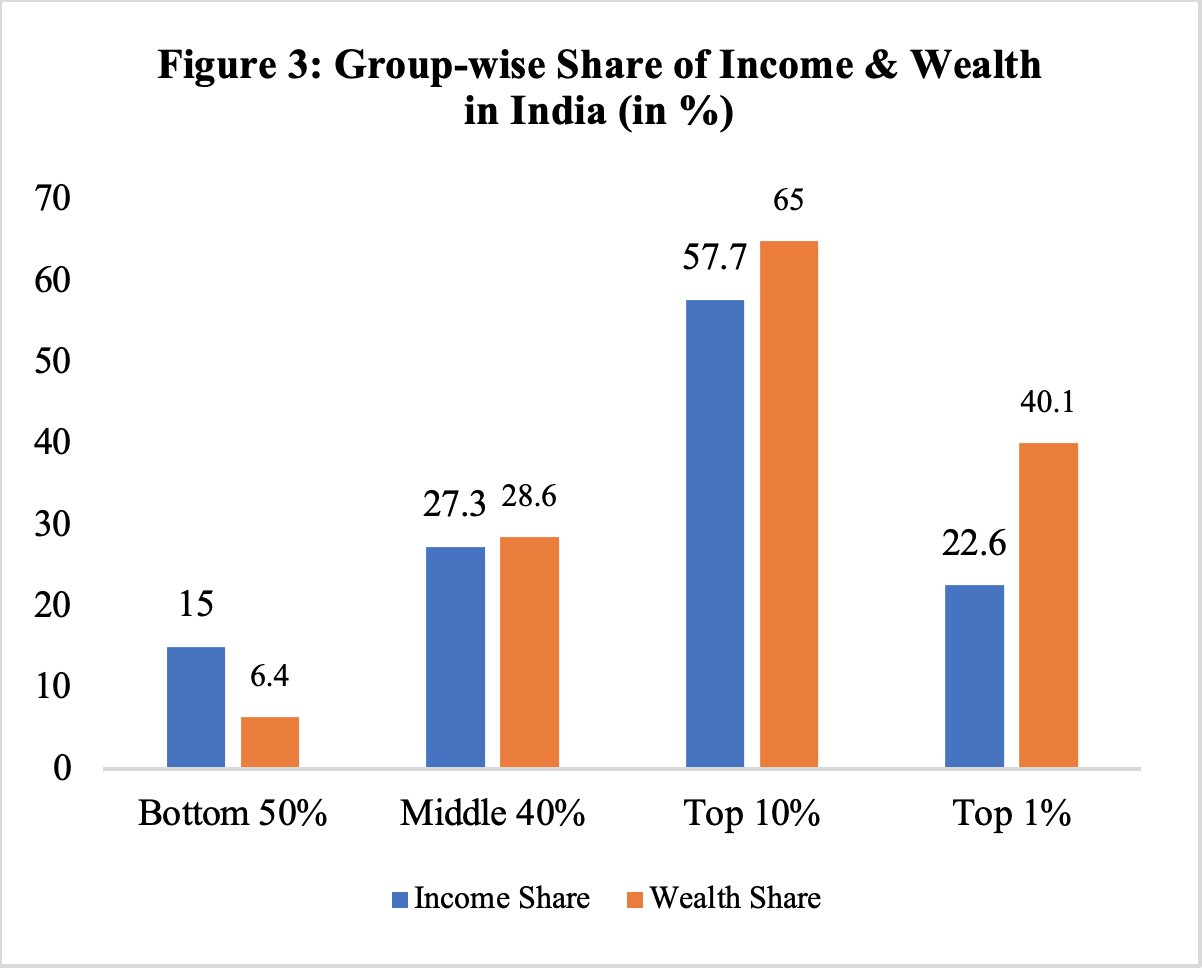
While India’s consumption inequality may appear to be declining, its income inequality is rising sharply, with the top 1 per cent holding 22.6 per cent of income and 40.1 per cent of total wealth in 2022-23, the highest since colonial times (Figure-3). This reflects Thomas Piketty’s argument that when capital returns outpace economic growth, wealth concentrates at the top unless checked by redistributive taxation.
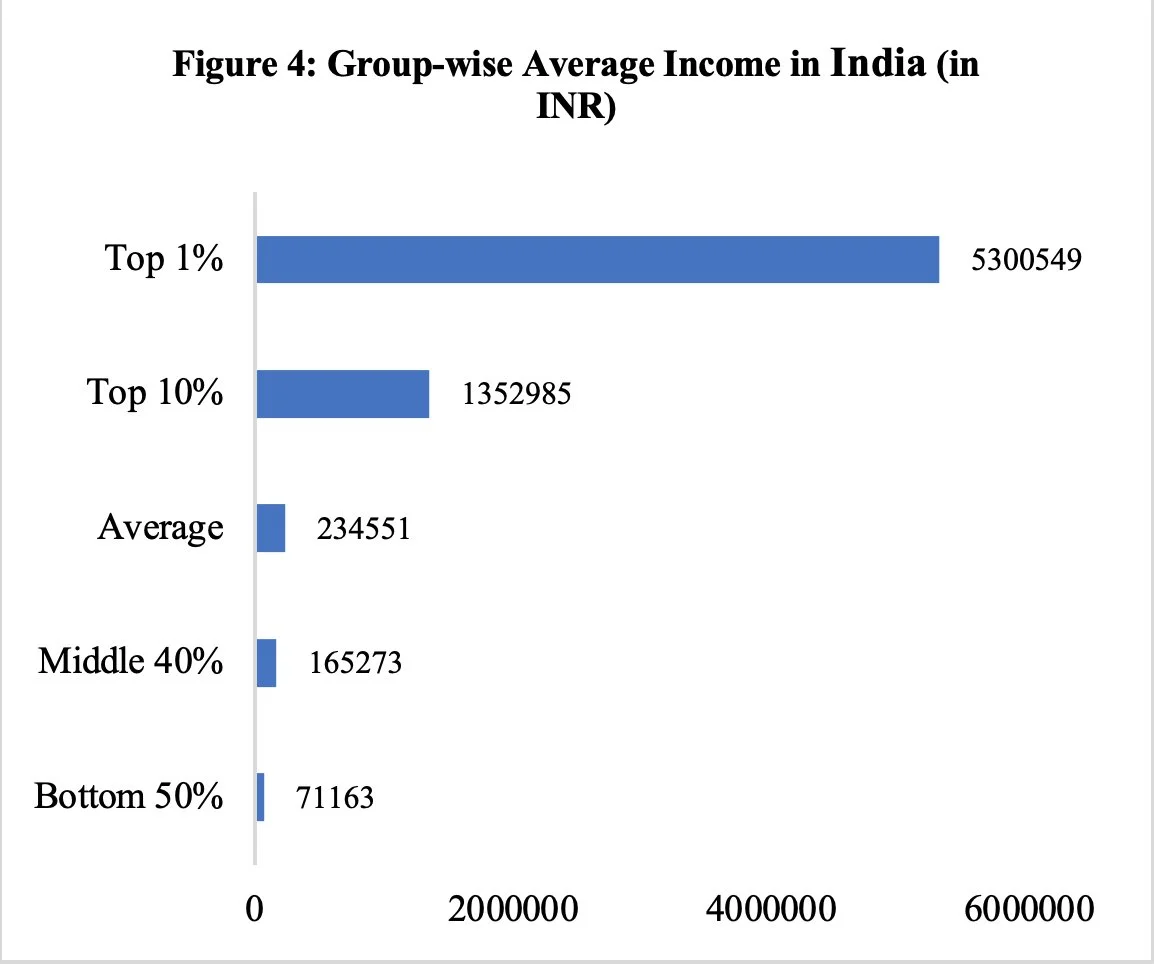
This is further evident by the fact that the average annual income of the bottom 50 per cent lingers around INR.71 thousand, compared to the national average of INR.235 thousand (Figure-4). Moreover, the national income share for the top 10 per cent is close to 60 per cent, while the bottom 50 per cent receive just 15 per cent of it, making the wealthiest ten-thousand individuals to acquire an average wealth (INR.22.6 billion each) that dwarfs the national average by over 16700 times.
Source: World Inequality Lab
This tension between income and consumption persists, as income is often more volatile and better reflects deep-rooted disparities, particularly at the very top. Consumption, on the other hand, is smoother across income groups because people borrow, receive transfers, or dip into savings to maintain a standard of living.
In welfare economics, Amartya Sen’s capabilities approach posits that inequality must be assessed not just in terms of what people consume, but in their ability to convert resources into meaningful opportunities. A person who intakes same number of calories as another may still lead a less empowered life, if their access to education, healthcare, or secure employment is lacking. Thus, a falling consumption Gini accompanied by a rising income Gini underscores the limitations of consumption-based equality.
A way forward…
The narrative that India is now among the ‘most equal’ countries may breed complacency or even policy reversal, especially when the country is grappling with declining labour force participation, rising informalisation, and wage disparities with the top 10 per cent earning 13 times more than the bottom 10 percent.
To move beyond this, India should integrate income tax and administrative data with household surveys to capture disparities at the top more accurately. Moreover, it also calls for a fairer fiscal framework with expanding tax base to make direct taxes more progressive, while curbing evasion to free up resources for public investment, so that they can be directed towards expanding access to education, healthcare, nutrition, and skills.
Finally, as noted by Joseph Stiglitz, informational asymmetries in data collection under differential non-response, where the wealthiest are least likely to participate in surveys, mask the true extent of inequality. Celebrating a dip in inequality without acknowledging such methodological blind spots undermines the foundations of informed policymaking. One should note that true equality is about expanding human freedoms, not just flattening graphs, and for that, India needs far more than a low Gini index; it needs equity in opportunity, voice, and dignity.
Sagartirtha Chakraborty is a Ph.D. Research Scholar in the Department of Economics at Cotton University, India. His research interests encompass the areas of entrepreneurial ecosystems, international relations, and contemporary policy narratives on geopolitics and development. He has author a book, titled “Research in Social Science: A Beginners’ Handbook” and his peer-reviewed articles are published in the London School of Economics and Political Science, Leiden Madtrics, Space & Culture, State Statistical Atlas, and over 15 edited volumes.
To cite this essay, please use the bibliographic entry suggested below:
Sagartirtha Chakraborty, “India’s inequality puzzle: What the World Bank’s numbers reveal and conceal,” criticalasianstudies.org Commentary Board, February 2, 2026; https://doi.org/10.52698/MGLI4393.