
Commentary | Jiahao Zhao, When War Turns Women into Flags: The Trouble with Rescue Politics
Mourning as a Political Image
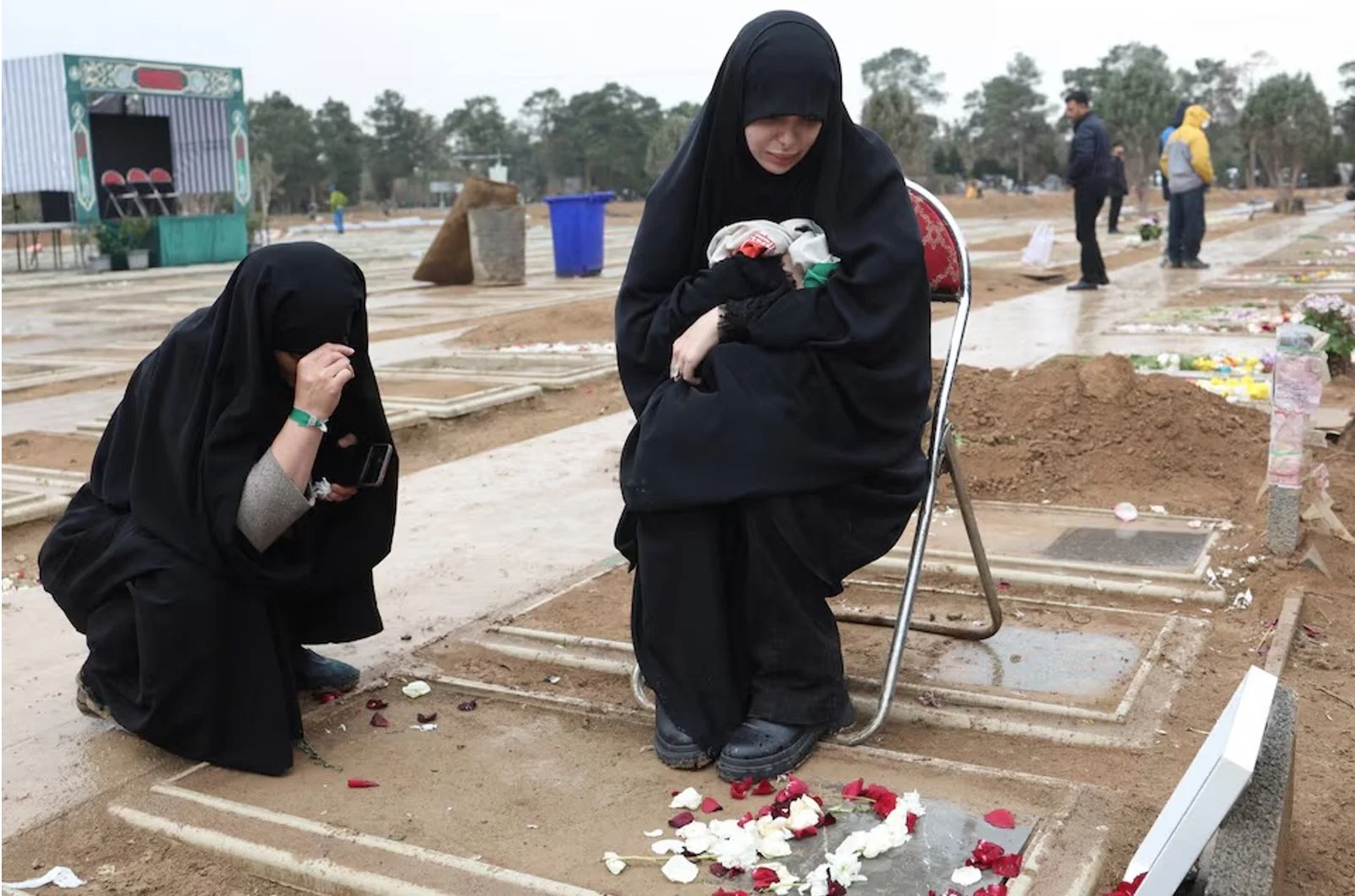
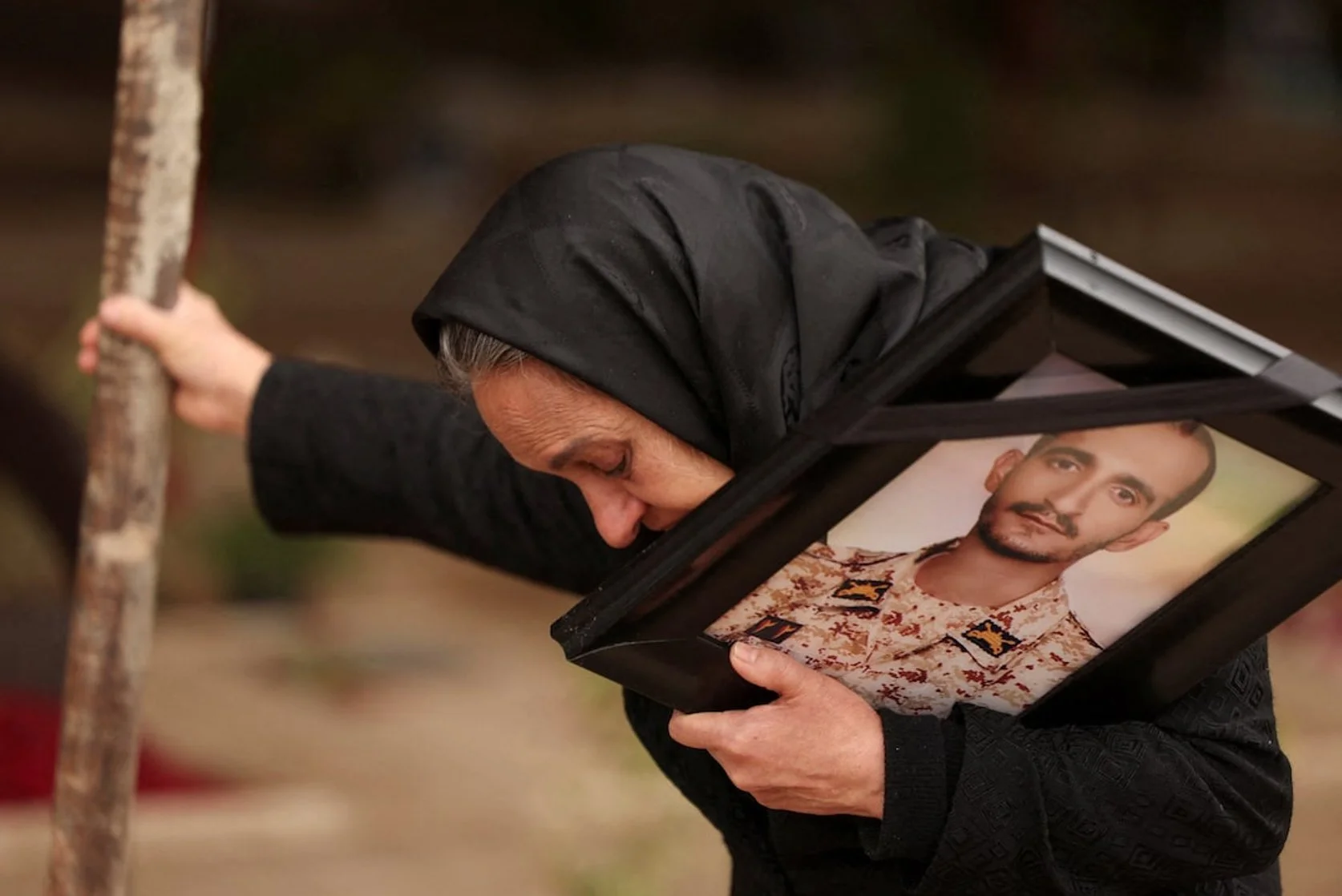
In Tehran’s Behesht-e Zahra cemetery, women gathered around new graves as families buried those killed in the latest round of war. A Reuters photograph from March 16 captures the scene with painful clarity. Women sit close to the earth as the funeral of Abdullah Pour Hossein moves forward under rain and smoke. Nearby, another mother, Marzia Rezaei, holds the portrait of her son Erfan Shamei, killed just before he was meant to come home and prepare for his wedding. These images matter because it takes war out of the language of strategy and puts it back inside the family.
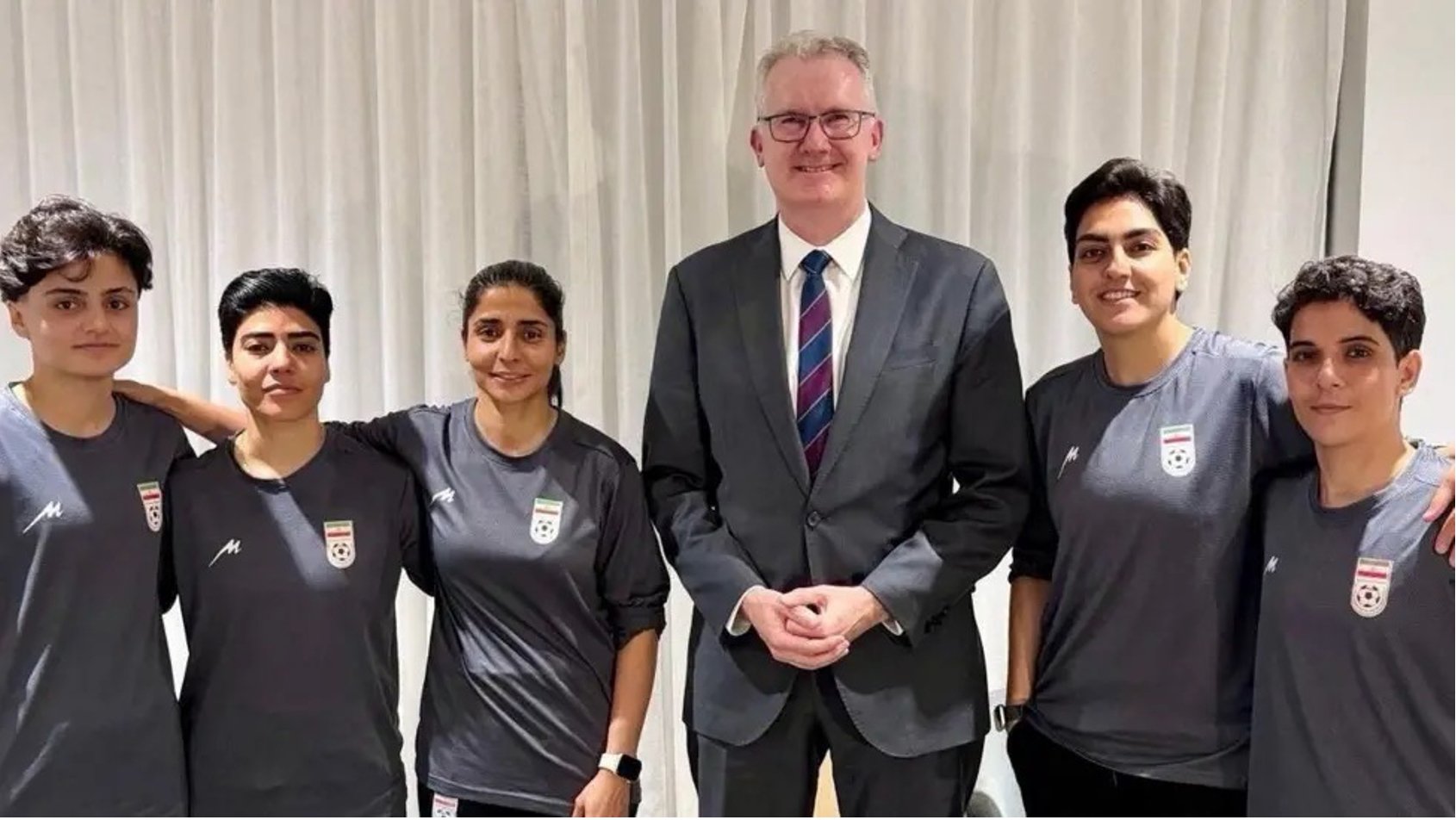
At almost the same time, Iranian women were being made visible in a very different way abroad. During the AFC Women’s Asian Cup in Australia, several members of Iran’s women’s football team refused to sing the national anthem. Some later sought humanitarian visas because they feared what might await them if they returned home (although others eventually went back according to latest report). Their silence was quickly reframed as a story about repression, resistance, rescue, and national loyalty.
These two scenes are different, but they are tied together by the same problem: Women stand at the center of wartime spectacle, yet they rarely control the meaning attached to their presence. In one frame, mourning women are folded into stories of sacrifice and national unity. In another, athletes become evidence for a larger narrative about freedom, regime change, or the need for outside intervention. In both cases, women are visible. In both cases, they risk disappearing as political subjects.
What War Takes from Women
The first point is simple - war harms women in material ways before it ever turns them into symbols. According to the World Health Organization (WHO), by mid-March more than 1,300 people had been killed in Iran and more than 7,000 injured. The WHO had verified 18 attacks on health care, and six hospitals had been evacuated. Meanwhile, United Nations Children's Fund (UNICEF) reported damage to at least 20 schools and 10 hospitals and said that 168 girls were killed when a strike hit the Shajareh Tayyebeh girls’ elementary school in Minab.
These numbers vividly describe how the conditions of ordinary life come apart. When hospitals are evacuated, treatment becomes harder to get. When schools are damaged, children lose not only education but also routine and safety. Reuters also reported that the war was disrupting the movement of critical medicines, including cancer treatments, as key air routes and logistics hubs were thrown into chaos.
Additionally, the burden does not fall evenly. When public systems fail, care is pushed back into the household. “Someone” has to find food, calm frightened children, look after injured relatives, and manage everyday life under conditions of fear and shortage - very often that “someone” is a woman. UN Women warned early in the escalation that military strikes were disrupting essential services, increasing the risk of gender-based violence, and further endangering women-led civil society. In sum, war does not simply add violence to women’s lives. It reorganizes daily survival around grief and exhaustion.
The Promise of Liberation
Still, the analysis cannot end there. We have to take seriously why some people read moments of war or regime crisis as openings. The Iranian state has long regulated women’s bodies, mobility, and public appearance (Rahbari, Longman, and Coene 2019). The UN Fact-Finding Mission on Iran stated in March 2026 that the persecution of women and girls remains a central pillar of state policy. Women and girls, it said, continue to be harassed, and sometimes beaten, for alleged noncompliance with the mandatory hijab.
That context is meaningful because this is also why the footballers’ silence mattered. It condensed a political desire that many observers immediately recognized. The appeal is understandable, but if women’s bodies have been used as one of the regime’s most visible instruments of control, then any weakening of that regime can look like the beginning of freedom.
Furthermore, that hope does not settle the question. Military rupture can damage a repressive order without creating a democratic or feminist one. The same UN Fact-Finding Mission on Iran warned that after the 2025 hostilities (there is an armed conflict between Iran and Israel for 12 days in June 2025), repression deepened, internet shutdowns concealed abuses, and detainees were transferred under coercive conditions after the Evin prison strike. This essay argues that: war may weaken one structure of domination while strengthening others, especially militarization, surveillance, and emergency rule. There is no straight line from bombing to emancipation.
The Trap of Rescue Politics
This is where rescue politics enters. This is where internal repression and external critique converge. The Iranian state governs through coercion, punishment, and restriction. Even so, internal nationalism and external rescue discourse can converge in one crucial respect. Both can use women instrumentally. Both can speak about women while speaking over them.
Yuval-Davis (1998)’s argument remains useful here. She argues that national projects repeatedly turn women into carriers of collective meaning. Women become markers of cultural continuity, moral order, sacrifice, and the boundary of the community itself. In wartime Iran, that logic becomes sharper. Mourning women at the cemetery can be read as proof of national endurance. Women athletes who refuse the anthem can be recast as tests of loyalty or betrayal. External rescue narratives reverse the moral language but often keep the same structure, because women can be made legible mainly as victims who authorize intervention (Abu-Lughod, 2015). Once that happens, the political complexity of women’s lives is flattened. The question stops being what women are demanding, organizing, or debating, and becomes whether their visible suffering can justify pressure, escalation, or even war.
The recent football case makes the problem concrete. Some players sought protection. That need was real. Humanitarian visas mattered. But the public story built around them was often too neat. It cast the players as either heroines of liberation or daughters reclaimed by the nation. In fact, their choices were made under fear, family pressure, public scrutiny, and rapidly changing political conditions. Some stayed. Some returned. That unevenness is precisely the point.
This is why rescue politics might slide into a “trap”. It promises agency in the future while reducing women’s agency in the present. On the one hand, it says women will be free later, once the right military or geopolitical outcome is achieved. In the meantime, on the other hand, their value lies in what they symbolize for others. In this sense, the state turns them into flags of sovereignty. Outside powers turn them into flags of civilization or intervention.
Bring Women Back into Politics, Not War
A feminist response must reject that arrangement. Women in Iran should not have to choose between repression from within and militarized “salvation” from outside. The first task is immediate. Stop the war and stop the harm. The International Committee of the Red Cross has warned that humanitarian aid cannot match the pace or scale of suffering caused by continuous conflict, it cannot repair what bombardment keeps destroying.
The second task is political. Women’s emancipation has to be pursued through the institutions and struggles that can actually sustain it: political participation, labor rights, legal reform, education, health care, and women-led social movements. The UN Fact-Finding Mission called for immediate diplomatic action to halt the conflict and for dialogue on peace, justice, human rights, and equal participation in political and public affairs, including women, youth, and minorities. That is the right horizon. It is slower than the fantasy of rescue, but it is more honest about what freedom requires.
Lastly, there is also a broader theoretical discussion. War does not only destroy bodies and institutions. It also reorganizes political language. It determines in advance who will appear as a subject, who will appear as evidence, and whose suffering will be translated into someone else’s claim to authority. That is why rescue politics should be understood not just as a bad argument, but as a mode of governance. In that grammar, women are acknowledged, but only in forms that remain useful to states, media, and geopolitical projects. A feminist critique should interrupt that process at the level of representation and at the level of power. Put differently, the issue is not only whether women are included in the story of war. It is whether they can act, speak, disagree, and organize without first being reduced to an alibi for violence. That is the deeper stake. Antiwar feminism is not an ethical supplement to politics. It is a theory of politics itself.
For that reason, scholarship should make that point clearly. It should refuse authoritarian control over women’s lives, but it should also refuse the idea that “bombs can deliver feminist politics”. Women in wartime Iran are political actors. The task is not to rescue them into symbolism once again. It is to make room for their politics in the present.
Dr Jiahao Zhao holds a PhD at Loughborough University, UK. Jiahao’s research examines how state-regulated family planning policies, particularly China’s three-child policy, shape working women’s career experiences, fertility decisions, and everyday life. More broadly, Jiahao’s work explores the links between gender, work, organisation, and social policy, with a focus on how macro-level policy shifts are translated into organisational and family life. Jiahao’s recent and ongoing work engages with gender inequality, reproductive governance, masculinity, critical perspectives on careers in contemporary China, and feminist politics in global contexts.
To cite this essay, please use the bibliographic entry suggested below:
Jiahao Zhao, “When War Turns Women into Flags: The Trouble with Rescue Politics,” criticalasianstudies.org Commentary Board, May 4, 2026; https://doi.org/10.52698/EIHL6583.