Special Series | Samuel I. Cabbuag, Propaganda for social justice? Influencer propaganda, digital vigilantism, and the search for political "nepo babies" in the Philippines
Introduction
In the second half of 2025, different cities across the Philippines experienced continuous flooding due to typhoons (Sampang and Flores 2025). These floods prompted protests, including the Trillion Peso March held on 21 September 2025 (Aquino 2025), as well as a series of Senate hearings featuring engineers, contractors, and public officials involved in various flood control projects across local government units (LGUs) nationwide. The Trillion Peso March was held again on 30 November 2025 to remind the public to identify individuals associated with the flood-control scam. Aside from the social movements, people began to put the faces of children of contractors, engineers, and public officials who are dubbed as “nepo babies” [short form of “nepotism babies,” henceforth as “NB”] on various social media (Beltran, 2025). These posts include showing the lavish lifestyles of the “NBs” wearing designer brands, traveling in various countries, as well as eating and partying around expensive restaurants and bars in their expensive cars. One specific post features a photograph of a female NB who is also a content creator; in that photograph, all her clothes, bags, and jewelry are designer brands, estimated to be worth hundreds of millions of Philippine Pesos [over 150,000 USD]. People also found an “NB” who produced their music videos. In fact, there is a collection of photos of “NBs” with the caption “iskolars ng bayan” [“Scholars of the nation”], implying that these people are using public funds for their lifestyles.
A cursory review of posts and their respective comments would reflect what digital media scholar Daniel Trottier (2017) calls “Digital vigilantism,” which refers to the coordinated retaliation of people on digital media due to being offended by other people’s activities. This is similar to the “human flesh search engine” used by regular users to search for corrupt officials in China (Gao and Stanyer 2014). However, digital vigilantism is also used in misogynistic ways in attacking Chinese intellectual women for being “unpatriotic” (Huang 2023). The central puzzle here is how vigilantism and propaganda figure in influencer cultures in the Philippines. In this essay, I will discuss studies on digital activism in the Philippines and on influencer studies, and then present strategies influencers use in calling out “NBs.” I will close with some concluding statements.
Influencer Propaganda in the Philippines
The past decade has seen an increase in social movements facilitated by social media or referred to as “digital activism” (Castillo et al., 2023; Mundt et al., 2018). In the Philippines, digital activism has also been evident; some instances were observed during the COVID-19 pandemic. Often, people post social media threads that include information serving as a form of “call-out” regarding an issue. This will prompt others to contribute to the thread by providing more information and insight into the issue. What I find interesting here is the roles of influencers in riding this trend and participating in this search for “NBs” and their parents who are linked to the flood control scandal. Influencers and their activism have been studied well in the literature (Glatt and Banet-Weiser 2021; Thomas and Fowler 2023, Tufecki 2013). Glatt and Banet-Weiser (2021), for example, explored how women YouTubers navigate their identities as feminist activists and participate in influencer logics. In the Philippine context, studies tend to focus on influencers’ complicity to “influence operations” (Lanuza and Ong 2024), which opens up the space to reflect on how influencers participate in various forms of activism.
Scholars have also examined influencers who leverage various controversies or scandals, even creating their own, to boost their online engagement (Lewis and Christin 2022; Shen and Abidin 2025). In the Philippine context, influencers make use of being made fun or what is colloquially termed as dogshows where internet users choose a “dog” which will then be subject for humorous jabs to the chosen dog (Cabbuag and Abidin 2024). Influencers engage in self-inflicting dogshows as an invitation to commentators to open fire in the comments, adding more dogshow comments, which then would increase their post’s engagement.
Strategies of influencer propaganda (Xu and Schneider 2025) are understudied in digital activism in Southeast Asian contexts. Xu and Schneider (2025) define “influencer propaganda” as the communicative strategies employed by influencers in promoting political and ideological agendas through popular content and emotional appeals. I present that influencers in the Philippines engage in digital vigilantism as part of their propaganda for two reasons. First, they engage in digital vigilantism to contribute to political discourse as a form of activism. Second, they participate in digital vigilantism as a form of “taking space” in attention economies as leaders in online conversations and ultimately maintain their spots as influencers in digital platforms. The next section presents strategies in the search for “NBs.”
Strategies
In the context of digital vigilantism targeting politicians’ “NBs,” influencer propaganda can manifest as memetic responses or “call-out videos.” The first strategy refers to memetic responses where content creators use imaginaries of “NBs” into memes through the practice of dogshows (Cabbuag and Abidin 2024). By using dogshow as memetic responses, influencers make fun of “NBs” while also putting upfront the discussions of their families’ lavish lifestyles. They would mock the way “NBs” wear expensive clothes by copying the outfit and pose, making it a meme (see Figure 1 as an example). In fact, some of the outfits from the “NBs’’ pictures were turned into Halloween costumes and posted across social media. Satire and humor will continue to be weaponized to target public figures allegedly linked to the country's large network of corruption, especially since these memes are prominent within attention economies.
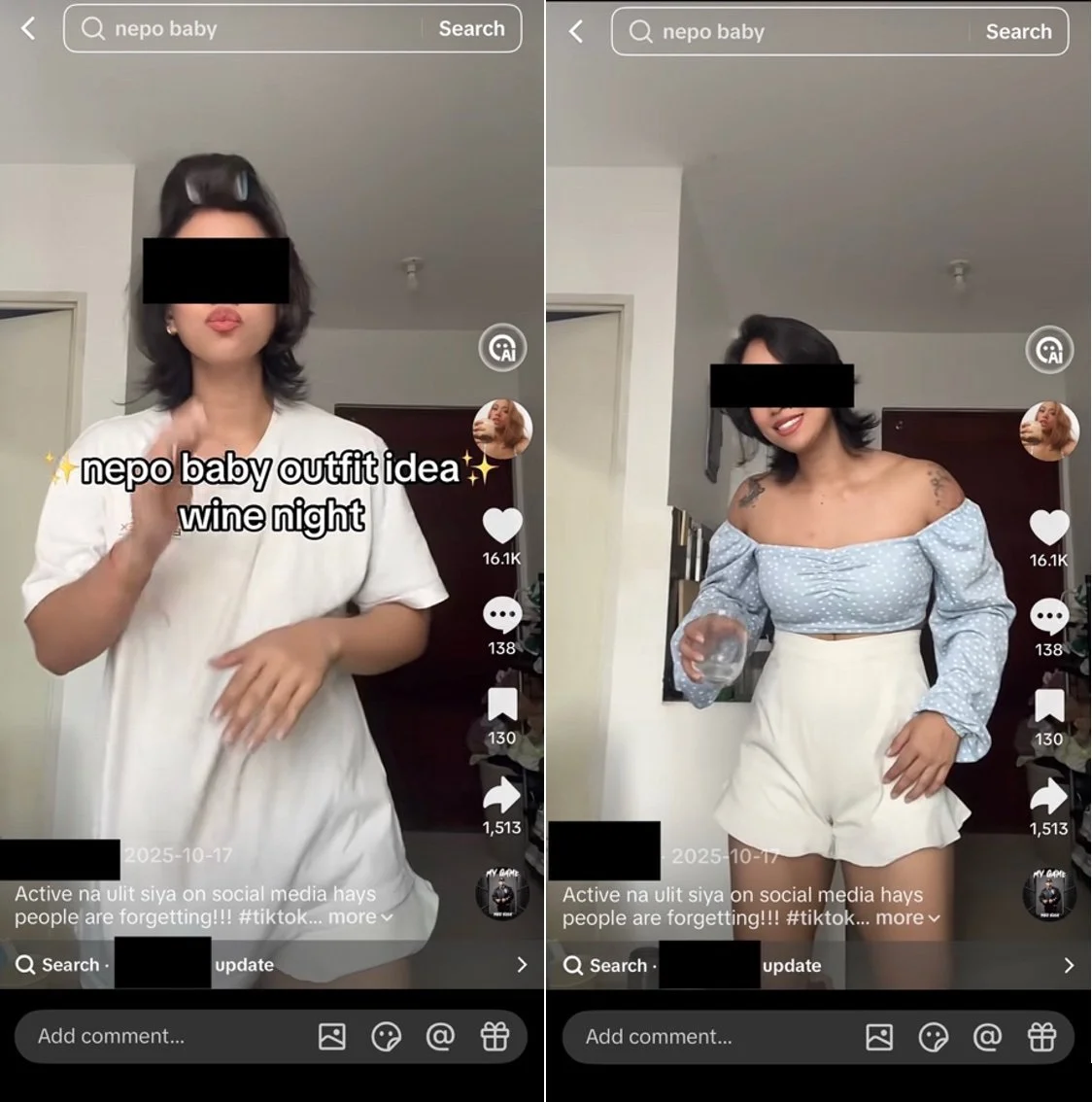
Figure 1. An example of a dogshow content of an influencer making fun of an NB by copying their style. Translated caption of the TikTok video: “She’s active again on social media *sigh* people are forgetting!” (screenshot by the author).
The second strategy is what I call “call-out videos.” This refers to content creators posting video essays of their thoughts on the issues. One example is a video with over 1.4M videos with a text saying “It’s time to normalize public shaming out of touch nepo babies from political dynasties.” A recent example (see Figure 2) is from a creator calling out the NBs who are posting on social media again after “hiding” since the scandal broke out, asking her audience to continue “shaming” them. This video has over 1.1M views and commentators would also share their thoughts on the issue. These “call-out videos” serve as “wake-up calls,” as they prompt viewers to engage critically with the issue. This strategy of calling out in videos shows how moral-affective content can be utilized in influencer propaganda. We can see how influencers will continue to be pivotal figures in propaganda work.

Figure 2. A video of a creator reacting to NBs returning to posting vlogs on social media. Screenshot by the author.
Conclusion
This essay aimed to explain how influencers in the Philippines engage in influencer propaganda through digital vigilantism in the context of the search for the “NBs” of political figures related to the flood control scandal. I presented two strategies of how influencers participate in the search for the “missing” “NBs” and their parents. I argue that young content creators in the Philippines participate in influencer propaganda to demonstrate that they are not merely pawns in influence operation networks, nor are they tagged as “fake news peddlers” online. Think of it as propaganda for “social justice.”
While focusing on “NBs” may not be the most ideal solution to the entire scandal, it demonstrates how influencers mobilize online to call for justice amid widespread corruption in the country. This is akin to Soriano and colleagues’ (2021) term digital labor bayanihan [trans. “Helping each other in times of crisis”] where influencers join in the discussion, making the flood control scandal more known to the people who might not be updated with the news. These strategies reflect that influencers can use their agency for social justice, which is supported by their audience, and then amplified by algorithms. Therefore, power is being negotiated in digital spaces as to who has the skills to navigate attention economies.
In a space where hate speech and hyper-partisan content continue to flourish, it is a breath of fresh air to see influencers participate in joining the call for good governance and social justice. Overall, we can infer that influencers will continue to shape the conversation regarding public issues. Future studies are recommended to explore how influencer propaganda works in other politically polarized contexts.
References
Aquino, Lyza. 2025. Thousands join “Trillion Peso March” at EDSA to protest corruption. ABS-CBN News. September 21. https://www.abs-cbn.com/news/nation/2025/9/21/thousands-join-trillion-peso-march-at-edsa-to-protest-corruption-1609 (accessed 29 December 2025).
Beltran, Sam. 2025. Why Filipinos flood social media to shame ‘‘NBs’’ amid US$9.5 billion scandal. South China Morning Post. September 1. https://www.scmp.com/week-asia/people/article/3323862/why-filipinos-flood-social-media-shame-nepo-babies-amid-us95-billion-scandal (accessed 01 November 2025).
Castillo-Esparcia, Antonio, Lucía Caro-Castaño, and Ana Almansa-Martínez. 2023. “Evolution of Digital Activism on Social Media: Opportunities and Challenges.” El Profesional de La Información. May 9, e320303. https://doi.org/10.3145/epi.2023.may.03.
Gao, Li, and James Stanyer. 2014. “Hunting Corrupt Officials Online: The Human Flesh Search Engine and the Search for Justice in China.” Information, Communication & Society 17 (7): 814–29. https://doi.org/10.1080/1369118X.2013.836553.
Glatt, Zöe, and Sarah Banet-Weiser. 2021. “Productive Ambivalence, Economies of Visibility, and the Political Potential of Feminist YouTubers.” In Creator Culture: An Introduction to Global Social Media Entertainment, edited by Stuart Cunningham and David Craig. New York University Press.
Huang, Qian. 2023. “The Discursive Construction of Populist and Misogynist Nationalism: Digital Vigilantism Against Unpatriotic Intellectual Women in China.” Social Media + Society 9 (2): 20563051231170816. https://doi.org/10.1177/20563051231170816.
Lanuza, Jose Mari Hall, and Jonathan Corpus Ong. 2024. “From Disinformation Campaigns to Influence Operations: New Campaign Tactics and Legacy Media Bypass in the Philippines.” In The Routledge Handbook of Political Campaigning, 1st ed., edited by Darren Lilleker, Daniel Jackson, Bente Kalsnes, Claudia Mellado, Filippo Trevisan, and Anastasia Veneti. Routledge. https://doi.org/10.4324/9781003333326.
Lewis, Rebecca, and Angèle Christin. 2022. “Platform Drama: ‘Cancel Culture,’ Celebrity, and the Struggle for Accountability on YouTube.” New Media & Society 24 (7): 1632–56. https://doi.org/10.1177/14614448221099235.
Mundt, Marcia, Karen Ross, and Charla M Burnett. 2018. “Scaling Social Movements Through Social Media: The Case of Black Lives Matter.” Social Media + Society 4 (4): 2056305118807911. https://doi.org/10.1177/2056305118807911.
Sampang, Dianne and Keith Clores. 2025. From storms to earthquakes: How natural calamities affected Filipinos in 2025. Inquirer, December 23. https://newsinfo.inquirer.net/2158425/from-storms-to-earthquakes-how-natural-calamities-affected-filipinos-in-2025 (accessed 29 December 2025)
Shen, Sijun, and Crystal Abidin. 2025. “The Shelf Lives of Wanghong: Surviving Scandals for Internet Fame in China.” In The Hashtag Hustle, edited by Taylor Annabell, Christian Fieseler, Catalina Goanta, and Isabelle Wildhaber. Edward Elgar Publishing. https://doi.org/10.4337/9781035332816.00009.
Soriano, Cheryll Ruth, Earvin Charles Cabalquinto, and Joy Hannah Panaligan. 2021. “Performing ‘Digital Labor Bayanihan’: Strategies of Influence and Survival in the Platform Economy.” Sociologias 23 (57): 84–111. https://doi.org/10.1590/15174522-113027.
Thomas, Veronica L., and Kendra Fowler. 2023. “Examining the Outcomes of Influencer Activism.” Journal of Business Research 154 (January): 113336. https://doi.org/10.1016/j.jbusres.2022.113336.
Trottier, Daniel. 2017. “Digital Vigilantism as Weaponisation of Visibility.” Philosophy & Technology 30 (1): 55–72. https://doi.org/10.1007/s13347-016-0216-4.
Tufekci, Zeynep. 2013. “‘Not This One’: Social Movements, the Attention Economy, and Microcelebrity Networked Activism.” American Behavioral Scientist 57 (7): 848–70. https://doi.org/10.1177/0002764213479369.
Tufekci, Zeynep. 2014. “Social Movements and Government in the Digital Age: Evaluating a Complex Landscape.” Journal of International Affairs 68 (1): 1–18. JSTOR. http://www.jstor.org/stable/24461703.
Xu, Jian, and Florian Schneider. 2025. “Influencers as Emerging Actors in Global Digital Propaganda.” European Journal of Cultural Studies, July 5, 13675494251351221. https://doi.org/10.1177/13675494251351221.
Samuel I. Cabbuag is a PhD Sociology candidate at the Department of Sociology, Hong Kong Baptist University. He is also an Assistant Professor of Sociology at the University of the Philippines Diliman. Reach him at @samcabbuag.bsky.social.
To cite this essay, please use the bibliographic entry suggested below:
Samuel I. Cabbuag, “Propaganda for social justice? Influencer propaganda, digital vigilantism, and the search for political "nepo babies" in the Philippines,” criticalasianstudies.org Commentary Board, March 22, 2026; https://doi.org/10.52698/XBTQ7807.