
Notes from the Field | Sia X. Yang, No Pain, No Exit – Endurance and the Limits of Critique in China
1.
Pain in contemporary China is not merely endured. It is organized, moralized, redistributed, and ultimately naturalized as value. To suffer is not simply to live under constraint; it is to demonstrate worth. Endurance becomes a credential; exhaustion, evidence. The capacity to continue – without refusal, collapse, or even the language to articulate dissatisfaction – functions as a pervasive, often invisible measure of legitimacy. Pain is no longer something that happens to people; it becomes the medium through which they are judged – and increasingly, through which they judge themselves. This transformation is neither reducible to culture nor adequately explained by ideology. It is structural. Pain operates at once as lived condition and governing logic: imposed yet internalized, resisted yet reproduced. Suffering becomes virtue; persistence, obligation; survival, a moral achievement. What disappears is not suffering itself, but the capacity to recognize it as a problem.
For many in China, optimism arises less from critique than from comparison. Set against famine, political upheaval, and prolonged scarcity, the present registers not as crisis but as relief. The memory of the Great Leap Forward famine – when hunger structured everyday existence – anchors this scale of judgment. The afterimage of the Cultural Revolution persists, when political volatility penetrated the most intimate domains of life, from schooling to kinship. More recent decades of rapid urbanization and mass migration – from subsistence agriculture to precarious industrial and service labor – consolidate a sense that instability is not episodic but constitutive. Conditions are rarely assessed in absolute terms but measured against prior extremes. The present becomes legible through contrast. Difficulty remains, but is re-scaled; strain persists, but no longer appears catastrophic. The past does not simply precede the present; it sets the terms under which the present can be judged.
The experience of the COVID-19 lockdowns intensifies this comparative structure. Prolonged confinement, restricted mobility, and the abrupt suspension of ordinary routines reintroduced constraint as a collectively shared condition rather than an individual exception, accompanied by circulating yet unverifiable rumors of suicide. Framed as temporary and necessary, these disruptions did not consolidate into sustained critique. They recalibrated perception: conditions once experienced as extreme could be endured and lifted; what followed could therefore appear manageable. The threshold of tolerability shifts accordingly – less in response to present conditions than to their position within a longer arc of remembered hardship.
Deaths produced by social and political conditions – their scale, uneven visibility, and uncertain accounting – enter perception only partially formed. They do not stabilize as objects of recognition, remaining dispersed, difficult to fix, at times unregistered. At once publicly sensed yet indistinct, they circulate between partial knowledge, muted acknowledgement, and formal constraint. Loss is not denied so much as rendered diffuse, absorbed into a field in which it resists consolidation as a shared point of reckoning. What follows is not a demand for accounting, but a muted accommodation. Life resumes without reflection, resolution, or compensation. This logic does more than contextualize suffering; it legitimizes it. If the present is better than the past, hardship can be reframed as necessary, even trivial. Suffering registers not as failure but as progress. To complain is to forget history; to endure is to recognize it. Critique is displaced by gratitude; dissatisfaction becomes suspect. The question shifts: not whether life should be different, but whether one has the standing to question it at all.
This displacement extends into everyday speech, humor, and the metaphors through which people describe themselves. These figures do not simply reflect reality; they organize how it is lived. In the 2010s, the term jiucai – “garlic chives” – circulated widely online: cut repeatedly, yet expected to grow back. Labor, time, and aspiration are harvested in cycles; violence is continuous but not terminal. Regrowth is assumed. The humor absorbs rather than releases tension, allowing exploitation to be recognized without being opposed. But a newer term renkuang – “human mine” – marks a different configuration. Minerals do not regenerate; extraction depletes. The shift from plant to mineral recasts life as exhaustible rather than renewable. What is consumed is not only labor but duration itself – time, health, attention, and the possibility of recovery. What emerges is a temporal horizon in which recurrence no longer guarantees renewal.
A widely circulated formula condenses this compression: twenty years of study, thirty years of mortgage repayment, the remaining decades spent managing declining health. Its force lies not in exaggeration but in recognition. Life appears no longer open-ended but pre-allocated, its future already spent in advance. Under the logic of jiucai, endurance remains cyclical; under renkuang, continuation persists without the expectation of return. The imperative remains, but its terms shift. What is sustained is no longer survival but depletion. Recognition does not produce rupture. Awareness coexists with continuation. The question moves from conditions to capacity: not whether life is just, but whether one can bear it. Structural critique yields to self-assessment; injustice is recast as personal trial.
2.
This paradox recalls what Lauren Berlant describes as “cruel optimism”: an attachment that sustains life even as it constrains it. Endurance takes this form, enabling continuation under demanding conditions while narrowing the space in which alternatives can be imagined. Persistence becomes a necessity; in continuing, one reproduces the conditions that require it. This logic is reinforced not only through discourse but through the organization of everyday life. Long working hours, intense competition, and structural precarity appear less as systemic conditions than as tests of character. Hardship becomes discipline; sacrifice, virtue; exhaustion, proof of seriousness.
This dynamic became sharply visible since the early 2010s, when a series of worker suicides at Foxconn led observers to describe its industrial complexes as a “labor camp,” “Apple’s Forbidden City,” or, more starkly, a “death pool.” From within this environment emerged the poetry of Xu Lizhi, an assembly-line worker who later took his own life at twenty-four. In I Fall Asleep, Just Standing Like That, he records not an exceptional breakdown but the normalization of depletion:
The paper before my eyes fades yellow
With a steel pen, I chisel on it unevenly black
Full of working words –
workshop, assembly line, machine, work card, overtime, wages…
They’ve trained me to become docile,
not knowing how to shout or rebel,
how to complain or denounce,
only how to silently suffer exhaustion.
What appears here is not simply alienation in the classical sense, but a condition in which exhaustion becomes a mode of discipline. The worker is reorganized around the capacity to sustain labor; desire contracts to the expectation of a monthly wage – “that grey pay slip” – as minimal consolation. The global brand remains luminous; the labor that sustains it recedes. Factory culture reinforces this structure through rituals of compliance: mass “morale” events, choreographed affirmation, discipline performed as collective participation. Punishment and pedagogy converge, producing subjects trained to internalize both labor and its cost.
Here, what Karl Marx described as alienation takes on a different inflection. It is no longer only that vitality is absorbed by the machine, but that exhaustion marks identity itself. Structural conditions are translated into personal obligation; the burden shifts inward, and justice yields to resilience. Michel Foucault’s account of biopolitics operates here less as theory than as description: power produces forms of life, defining what appears normal, necessary, and admirable. Individuals monitor themselves, measuring productivity and tolerance for strain; failure registers as moral deficiency as much as economic insecurity. Contradiction is not resolved but displaced, absorbed into the self. The system is not confronted but inhabited. The question is no longer structural constraint, but one’s capacity to sustain it – or to imagine an exit.
3.
The trajectory of the artist Zhang Yue traces both an attempted exit and the depth at which this logic is internalized, even as it remains unstable. On 27 May 2019, he received the title of “Young Artist of the Year” at the China Art Award ceremony in the Forbidden City. As the thirtieth anniversary of Tiananmen approached, he remarked on the weight of censorship, adding that receiving such an honor “so close to Tiananmen” left him “even more embarrassed.” The comment drew applause and effectively ended his career in China. He withdrew from public view, relocating to Jingdezhen, abandoning his phone, and preparing works for future sale. Emigration became a practical question: a United States EB1A visa proved costly and slow; instead, he moved to Okinawa in early 2020 under a Japanese business visa secured through his partner. What appears as departure is less rupture than reconfiguration – a shift that does not resolve the conditions it seeks to escape.
During a conversation amid the protracted Zero-COVID lockdown, Zhang remarked that he had been “released from prison twice”: first from Ji’nan prison, where he had been incarcerated as a teenager for involuntary manslaughter, into society, and then from China into exile in Japan. Freedom appears here not as an absolute condition but as something relative, shifting with changing forms of surveillance and constraint. Release does not resolve confinement but reconfigures it; freedom remains tethered to control, a threshold at which belonging and abandonment blur.
Zhang once sketched a taxonomy of contemporary Chinese society. The “lion” is rare – solitary, unwilling to submit. Others resemble “hyenas”: collective, competitive, indiscriminate. Most are “monkeys”: adaptive, agile, eager to please. The rest are “herbivores” – compliant and unthreatening. The schema places him, implicitly, among the “lions,” even as he continues to inhabit ordinary constraint. The figure carries an irony. In a milieu structured by capital, bureaucracy, and spectacle, it is not the “lions” who prevail, but the adaptable and the cunning, recalling Machiavelli’s counsel that power depends as much on the “fox” as on the “lion.” What appears as hierarchy dissolves into a field of adjustment, where survival depends less on autonomy than on accommodation. The “lion” becomes less a position than a gesture – a claim to moral sovereignty sustained symbolically, within the terms it seeks to oppose.
Zhang’s trajectory is not exceptional. Since the 1989 China/Avant-Garde exhibition – shut down by police on its opening day – contemporary Chinese artists have repeatedly encountered the same impasse: works censored or withdrawn, exhibitions cancelled, livelihoods disrupted, and the persistent choice between enforced silence at home or departure abroad. These trajectories reveal a condition in which artistic radicalism is both sustained and contained. Energies forged through struggle are redirected, absorbed, and at times appropriated. What once marked opposition can be rearticulated as value, folded into cultural diplomacy and soft power. The field that emerges is neither fully suppressed nor autonomous, but suspended within a shifting boundary where critique persists yet rarely escapes the conditions that produce it.
Within this field, Zhang’s designation as a “wild” (yesheng) artist poses a problem. The term denotes more than stylistic unruliness: it signals the absence of institutional training, often inflected by associations with roughness, vulgarity, and non-elite origins. Self-taught and marked by incarceration, he stands apart from his more credentialed peers. During four years in Ji’nan prison, he produced hundreds of drawings while reading extensively, including Dream of the Red Mansions – a dense account of decline, desire, and hierarchy in late imperial China, and one of the most demanding works of the classical canon. His trajectory unsettles the norms through which artistic value is recognized. To support such a figure becomes itself a test of the avant-garde, whose claim to newness, as Harold Rosenberg noted, has always provoked resistance, and, under more restrictive conditions, may approach sacrifice.
As Zhang has suggested, originality lies in producing what cannot be replicated. He points to He Yunchang’s use of the body: in 2010, a vote authorized a one-meter incision into his flesh. One Metre of Democracy stages participation as a procedure culminating in injury. Collective decision becomes the mechanism through which violence is enacted. Pain functions as both medium and address, converting suffering into confrontation – against the language of political participation, the passivity of spectatorship, and the limits within which art operates.
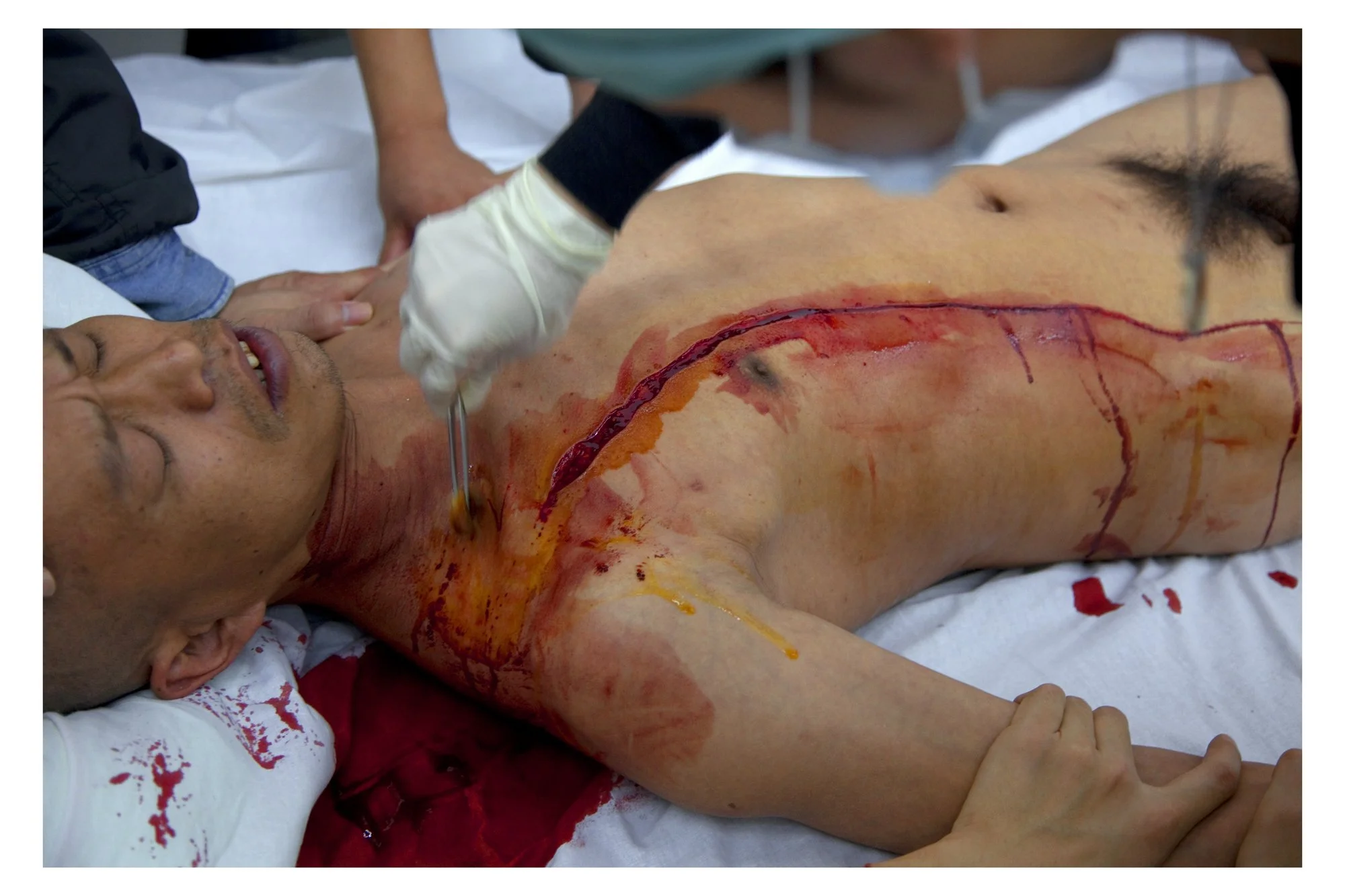
He Yunchang, One Metre of Democracy, 2010. Performance in Beijing (Image from the catalogue of Fuck Off II, Groninger Museum, 2013, curated by Ai Weiwei, Feng Boyi, and Mark Rappolt. Courtesy of Feng Boyi.)
Zhang proceeds otherwise, adopting iteration as method: drawing, copying, cataloguing. Creation arises through duration; difference emerges from sameness. His projects accumulate without resolution: thousands of shades of white, hundreds of copied magazine pages, archives of sound. Meaning does not stabilise but disperses. What is sought as originality is continually deferred, displaced into repetition. At the same time, his insistence on solitary execution – doing everything by hand – produces a regime of sustained, high-intensity labour. Fatigue ceases to register as an interruption and instead defines the conditions of making. The contemporary subject, as Byung-Chul Han observes, is driven less by external coercion than by an internal demand to perform. Zhang’s practice gives this dynamic a concrete form, converting depletion into value while reactivating what Rosalind Krauss identified as the “myth of originality”: the belief that singular authorship guarantees authenticity. Here, isolation and authorship reinforce one another, grounding artistic identity in disciplined repetition rather than rupture.
After a stay in New York, Zhang described a growing sense of dislocation, measuring the marginality of Chinese art against a longer Western horizon. Abroad, he found himself caught between competing projections – official nationalism on one side, oppositional rhetoric on the other – producing not clarity but distrust. This sensitivity condensed around the term “survival,” which he rejected as an index of deprivation rather than resilience. What emerges is a broader formation in which endurance is recast as self-sufficiency and vulnerability disavowed. Masculinity appears as performed stability, sustained through repetition and restraint; autonomy remains inseparable from discipline.
Zhang advised abandoning “Chineseness” as a framework altogether, turning instead towards English expression as a route into the mainstream. He recalled an anecdote: visiting Zao Wou-ki in Paris, a group of Chinese artists were received coldly; as they left, Huang Yong Ping dusted Zao’s shoes, prompting the remark, “Leave behind those Chinoises.” The episode condenses a lesson: departure entails not only geography but the relinquishing of a cultural horizon. Yet this renunciation carries a cost. In shedding it, the force that once animated artistic practice is diminished. What remains is a solitary condition, in which direction is no longer secured by shared narratives but negotiated individually – a space in which the avant-garde persists without ground.
4.
This dynamic is not unique to China, but is sharpened by a historical narrative that casts suffering as necessary, even redemptive. The past functions as a moral benchmark: against famine and upheaval, the present appears as relief. This comparative logic stabilizes existing conditions, narrowing the horizon of critique, as hardship is justified in relation to something worse. The language of jiucai and renkuang captures this ambivalence, naming exploitation while accommodating it, producing recognition without transformation. Pain is not eliminated but reorganized, absorbed into systems of value, expectation, and identity. If suffering becomes a measure of worth, its absence invites suspicion: ease appears as complacency, rest as weakness, refusal as failure. Alternatives recede not through prohibition but through moral reconfiguration. What remains is a condition in which pain no longer interrupts life, but defines it.
It becomes what life is – no longer interruption, but condition.
Sia X. Yang is an independent scholar based in Sydney, currently on an extended career break due to motherhood. Her work focuses on contemporary Chinese art and the politics of value, and has appeared in Asia-Pacific Journal: Japan Focus, Made in China Journal, Memo Review, Art Review Oxford, Burlington Contemporary, and Cultural Politics. She is developing a book project in association with SOAS, University of London.
To cite this essay, please use the bibliographic entry suggested below:
Sia X. Yang, “No Pain, No Exit: Endurance and the Limits of Critique in China,”criticalasianstudies.org Commentary Board, June 2, 2026; https://doi.org/10.52698/IZAA2795.