
Notes from the Field | Duncan McCargo, Chayata Sripanich and Karin Zackari, Prophetic Histories: The 4 October 1976 Hanging Play
Setting the Scene
The massacre of student protestors at Thammasat University at the hand of police, military and royalist paramilitary groups on 6 October 1976 is one of the most notorious episodes in Thai political history. But less is known about a crucial event two days earlier, one that prefigured and set the stage for the subsequent massacre itself.
In October 2024, Thammasat University library held a small exhibition displaying a number of photographs showing a 4 October 1976 student play – photos taken by a university photographer that had not previously been widely disseminated.
The play in question has been discussed for decades almost exclusively through the lens of one image: a picture of a student actor performing his own hanging. That image, reproduced in newspapers at the time, became the focus of controversy because of an alleged resemblance between the actor and the then crown prince. Was this accidental, or had the picture been doctored? Rumors that the play carried an anti-monarchical message helped inflame rightist sentiments against the students. But the additional images exhibited in 2024 told a larger story about a powerful dramatic performance in which the mock hanging was just one element.
Revisiting the 4 October student play is essential for understanding not just the 6 October massacre that followed, but for the recurring logic of Thai state violence across the next five decades. The theme of the play? The horrors of Thai state violence.
What Was Performed, and Why?
The immediate context of the play was the murders of Chumporn Thummai and Wichai Ketsriphongsa just eleven days earlier, on 24 September 1976. These two young Provincial Electricity Authority workers were lynched on a red iron gate in Nakhon Pathom by police, for posting leaflets opposing the return of former dictator Thanom Kittikachorn. Their bodies were displayed publicly; five police officers were arrested, but all of them were later released, no charges were brought, and no autopsies were conducted. Although by no means unique – many others were extra-judicially killed during this period, including leftist activists and farmers’ leaders – the brutal deaths of Chumporn and Wichai marked a new low for the rightist forces in Thailand. Their crime was to highlight the hot-button issue of the moment: Thanom’s re-entering Thailand sheltering behind monastic robes after being immediately ordained at a royal temple, Wat Bowornniwet — and the specific threat that Thanom’s rehabilitation posed to those who had fought to remove him three years earlier, during the pro-democracy protests of October 1973.
The Thammasat Drama Club decided to stage a protest performance at the Bodhi Tree Court, in front of the Faculty of Liberal Arts and close to where the protest gathered, during the examination period: a tactic to force the maximum number of students to make difficult choices at a crucial political juncture. Would they take part in their exams, or support the protesters in challenging the authorities?
The photographs at the Thammasat Archive that were displayed at the commemoration in 2024 show the whole skit: Students lying on the ground, depicting the dead of October 1973; a “Phra Thanom” character wearing monastic robes while holding a skull; a mock hanging representing the Nakhon Pathom murders; and exam boycott posters that connected the play with the students’ academic lives.
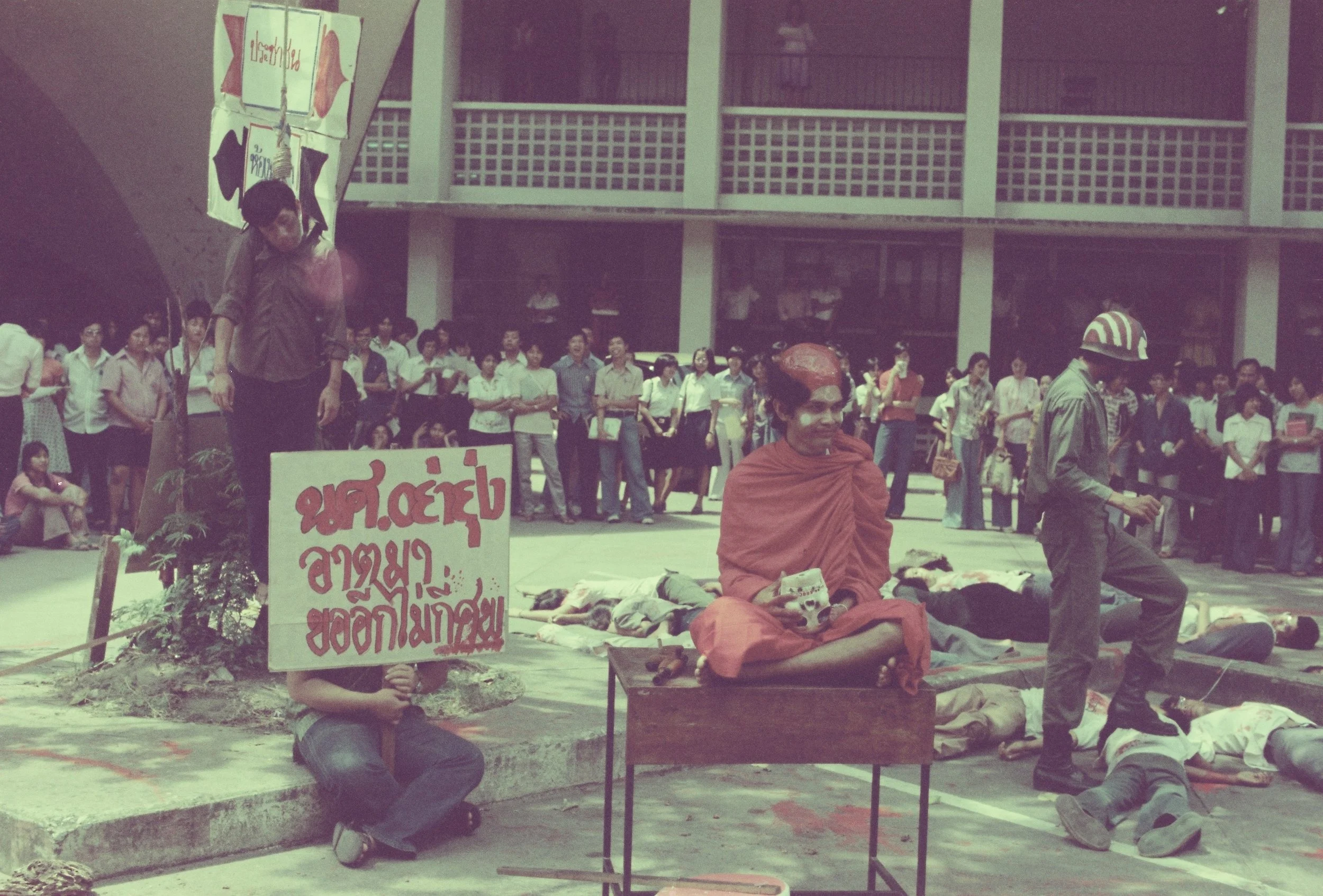
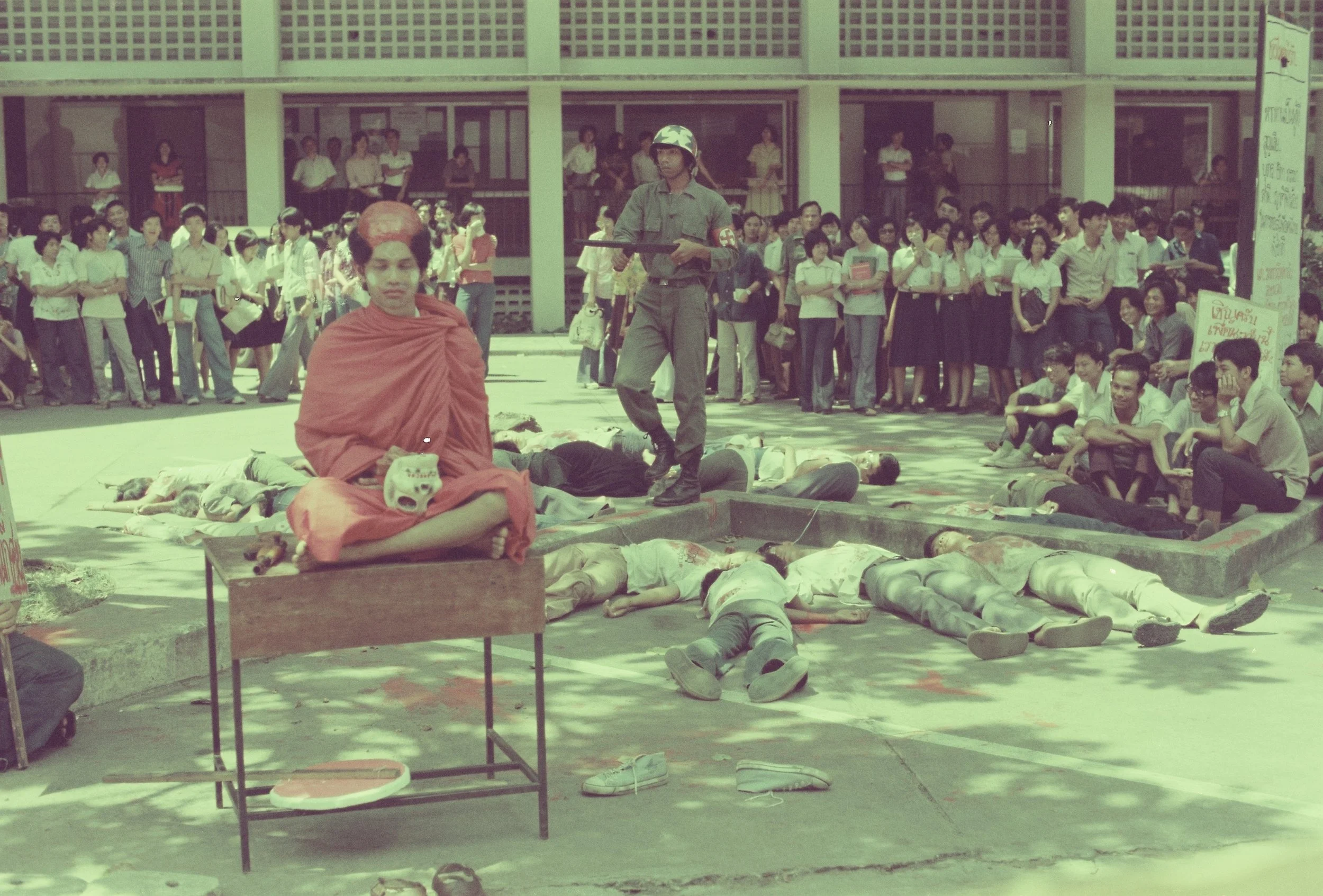
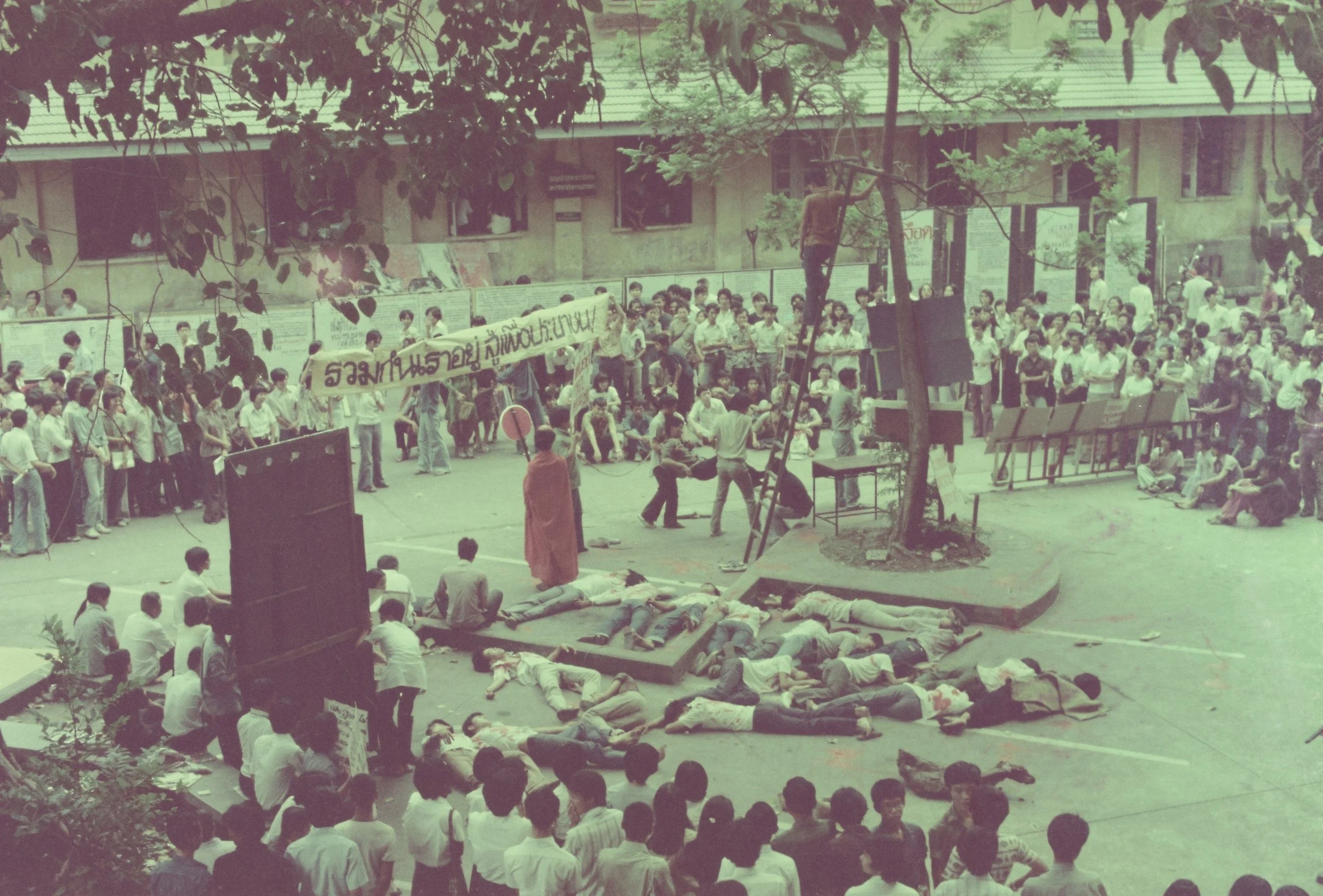
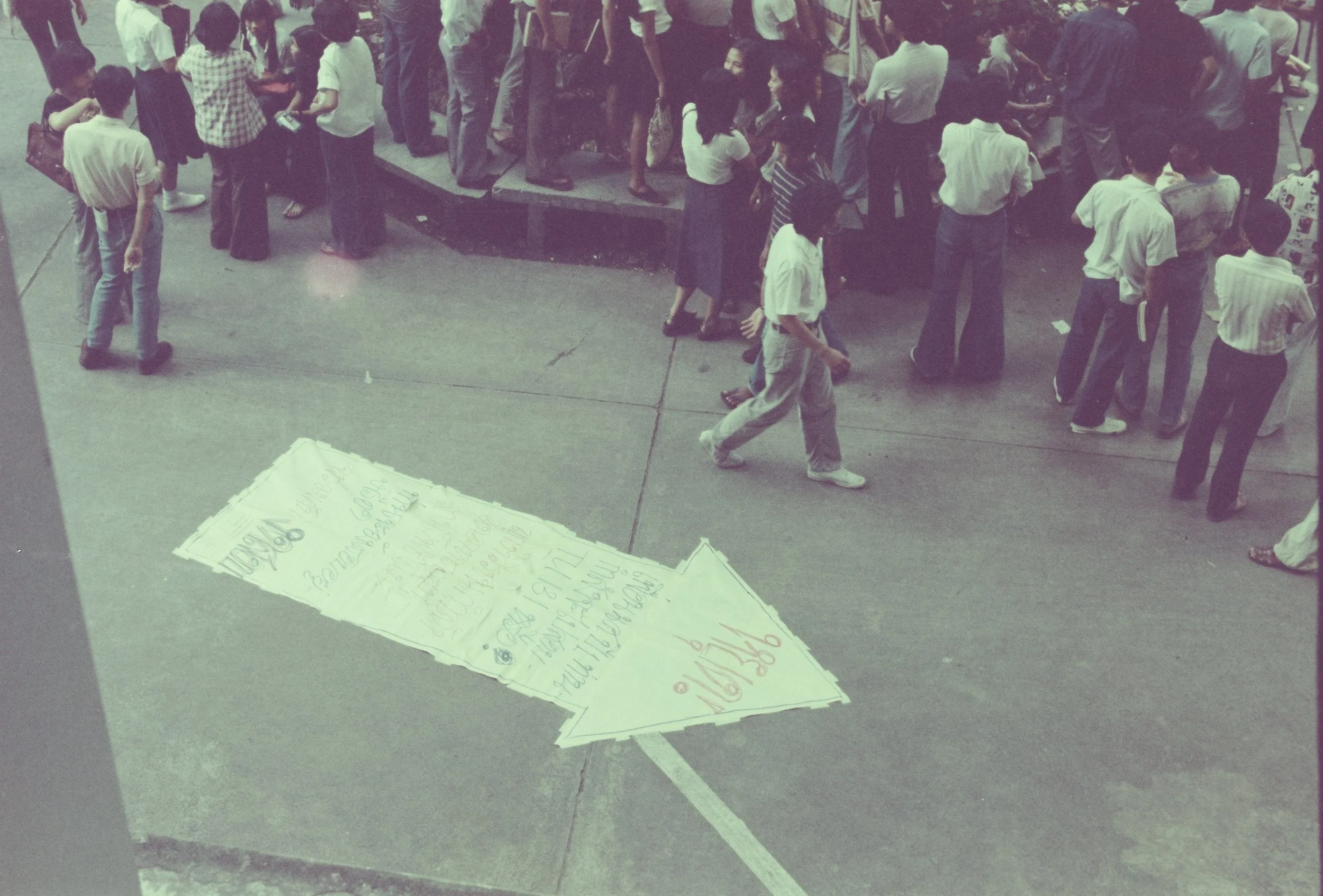
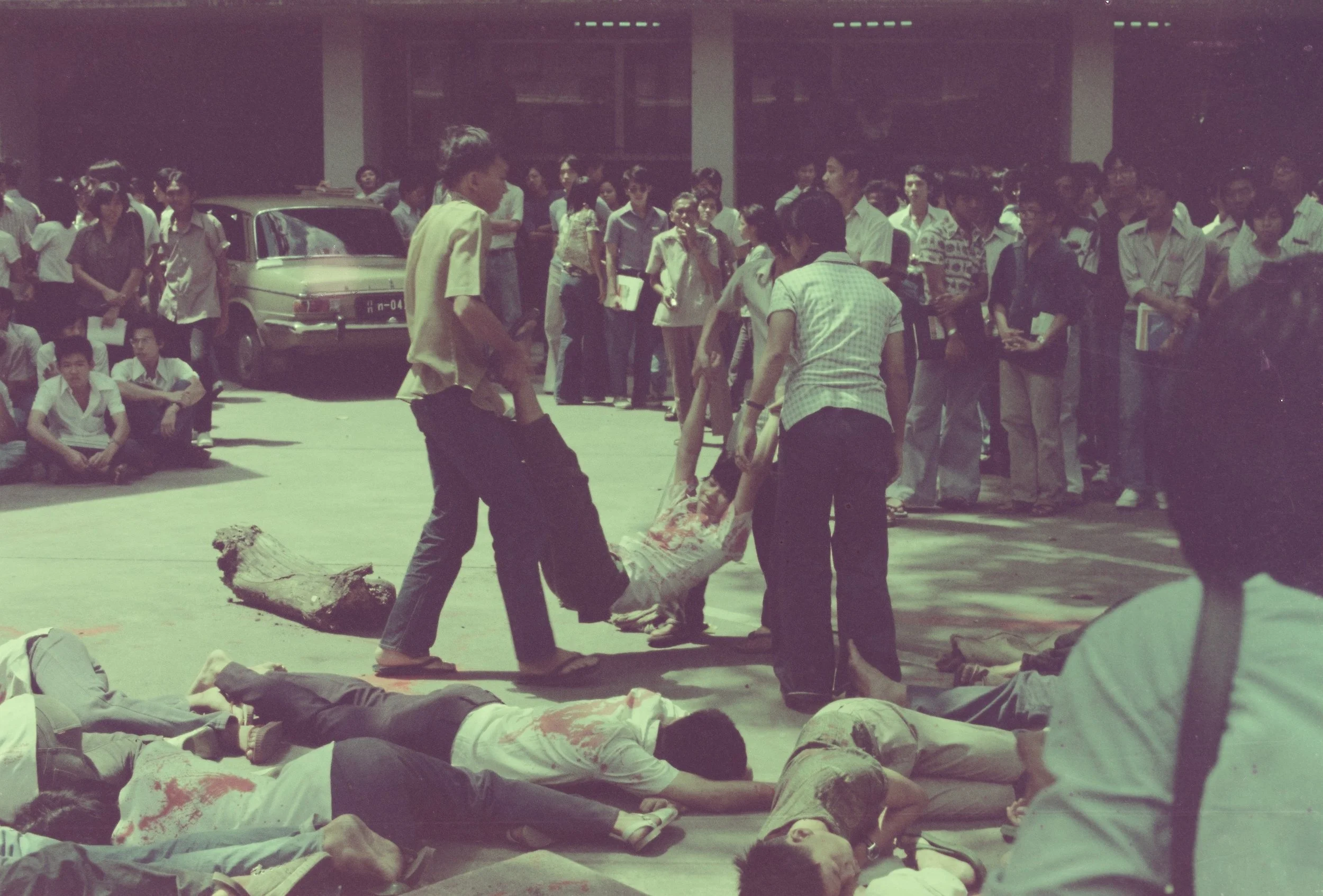
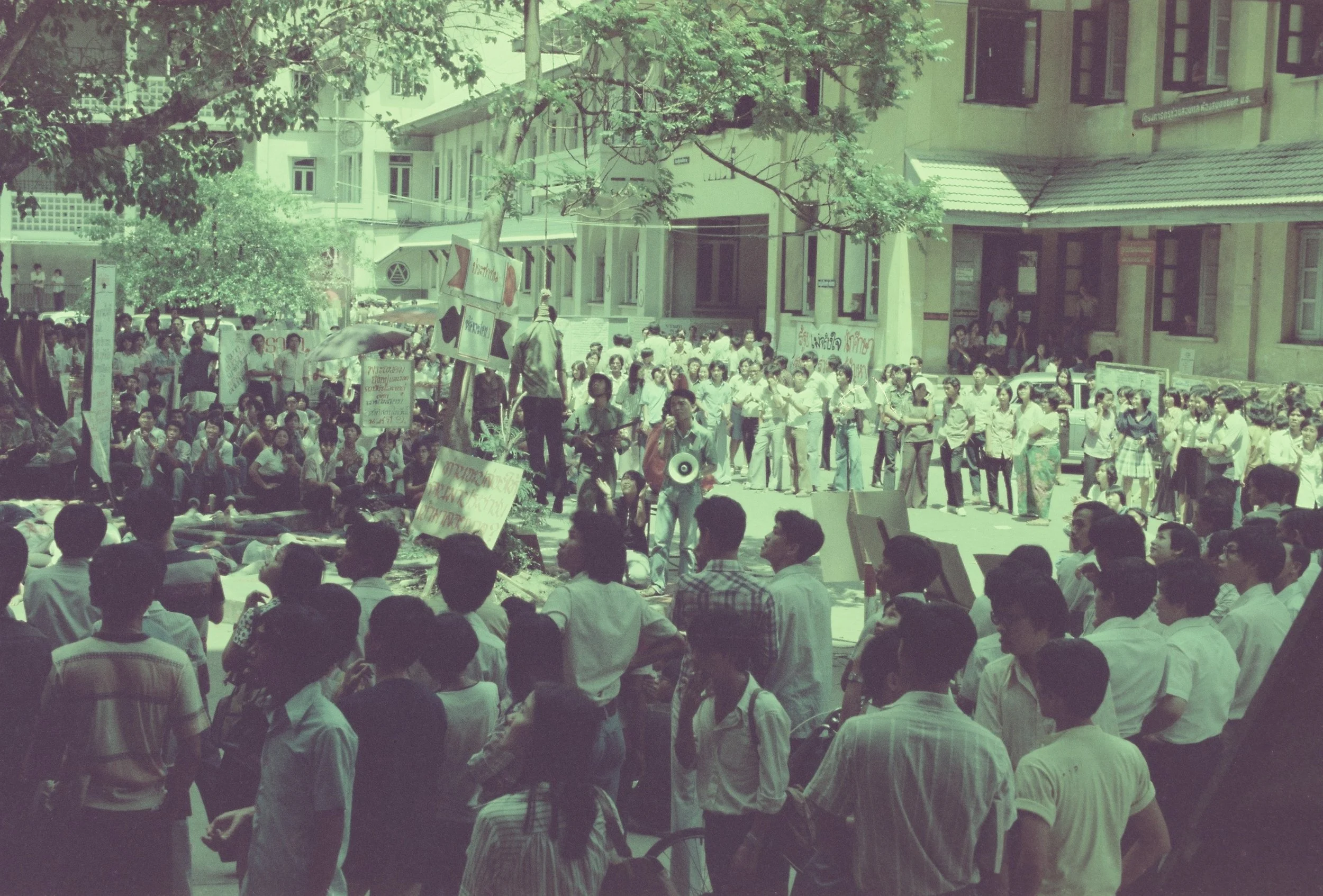
Credits: All photographs by Chin Klaipan, 1976. We are very grateful to Thammasat University Library for granting us permission to reproduce these copyrighted images.
In a 2019 interview, Apinan Buaphakdi, one of the student actors who played the hanged men, described the enactment:
The students were instructed to lie down in a row, like steps, and one student was assigned to act as a student dressed as if they were on their way to an exam. As they walked, they appeared confused by the sight of people lying in a row — injured or dead — blocking the path to the exam. Then, one person pushed himself up. The student asked, “Who are you? Why are you here? I need to get to my exam.”
One of the students lying on the steps responded, “We are the students and citizens who fought in the 14 October incident. We were injured and killed fighting for democracy. And now that the very situation we died fighting against has circled back around — are you still going to your exam?”
“Of course I’m going to take my exam. It’s my duty. I have to study. Success and a bright future are waiting for me,” the student actor replied.
“Fine then. Go ahead and take your exam. But you’ll have to walk over our corpses, one by one,” came the response.
Apinan recounted that after this, the student actors stepped over the bodies one by one. In the end, they couldn’t go through with it: they decided to throw away their books and not take the exam. The half-hour play was performed repeatedly for about before the exam was scheduled to begin. Sometimes, the characters would point toward Viroj [Tangwanich] or Apinan. [1]
These two students took turns acting out the hanging, because performing the role was very demanding and uncomfortable. In the end, around 20% of the students did not take the examination, which was later officially cancelled by the university.
The 4 October play was itself a significant historical event— not merely a prelude to an accusation – and was doing historical work before photographs of it were disseminated. The play was simultaneously a memorial to the fallen, a political statement, a set of demands, and a moral test for the audience. Those watching were challenged to risk throwing away their futures for the sake of democracy.
The Weaponized Image
The students deliberately invited the press to the play: they understood photography as political communication, and wanted their performance documented.
What happened next? Photographs from the play were published in several daily newspapers, but a particular picture of Apinan acting as one of the hanging victims was published on the front page of the Bangkok Post on the morning of 5 October, along with a short, factual news report.[2] Escalation followed: the Housewives' Association filed a lèse-majesté complaint at Chana Songkhram police station, calling for those involved in staging the play to be arrested, and the play was denounced on the military’s Armoured Radio station.[3] A cropped photograph of Apinan then appeared with an incendiary headline in a special afternoon edition of the right-wing newspaper Dao Siam.[4] Meanwhile, right-wing politician Samak Sundaravej and others amplified the narrative on television and radio.
Interviewed years later, Apinan stated that he was able to enter Thammasat unrecognized by the large crowd of nationalist vigilantes gathered outside on the evening of 5 October: the photograph bore so little resemblance to him that it had effectively become a different image. "I've never heard anyone say I look like him [the crown prince]".[5]
According to Apinan, during his trial the freelance photographer whose image appeared in Dao Siam later testified in court that "Nothing appeared unusual”, and that nobody during the performance commented on Apinan’s resemblance to a specific individual.[6] The incendiary rightist reading was constructed after the fact. Student representatives, including the play’s performers, held a press conference on the evening of 5 October, pushing back against the narrative that they were anti-monarchy, but this came too late for the morning newspaper editions.[7]
In any case, the violent crackdown began before any rebuttal could be published. While the students were protesting, right-wing vigilante groups were mobilizing, looking for a pretext to attack the protests. The Nation reported on 4 October from the mob gathering outside Wat Bowornnivet that they would "wipe them out for good" - meaning the student protesters - if they turned violent. By the evening 5 October the mob was already riled up, while the police were ordered to Sanam Luang during the night.
A performance opposing the return of a dictator was turned against those who staged it: once photographed, the students lost control of the meaning of their play. A photograph is full of potential ambiguity: an image can be weaponized, distorted, and used to manufacture offense.[8]
The Archival Lacuna
The 4 October Thammasat student play has been effectively reduced to that single image disseminated through newspapers, for nearly five decades, hence its nickname “The Hanging Play”. This was not because other photographs did not exist, but because they did not circulate.[9] The National Archives holds photographs from 14 October 1973, but none from 6 October 1976. The building housing the Police Forensic Department records was later destroyed by fire, while the original Dao Siam photograph "disappeared".
The cost of this particular lacuna: without the fuller photographic record, the play could only be discussed in terms of the lèse-majesté accusation. Its own themes, the Nakhon Pathom lynchings, the legacy of October 1973 and the dilemma facing a new generation, remained invisible. It was only around the commemoration in 1996 that a limited set of photographs from 6 October began resurfacing in the public sphere[10]– but a counter-discourse only really came to life through the systematic collection of photographs and newspapers by the archival project “Documenting 6 October”,[11] founded in 2016.[12]
Within this counter-discourse it is possible to see the 2024 display at the Thammasat Library as a partial correction, and an invitation to re-read the play as the students intended it to be read. Recovering what was missing is not merely an archival exercise; it changes what the play means, and so in turn it changes what the massacre means.
Performance, History and Prophecy
The play staged dead students lying on the footpaths of Thammasat University; two days later, actual dead students were lying on the footpaths of Thammasat University.
The play staged the threat of a returned dictator in monastic disguise; the massacre that followed installed one of the most conservative governments in Thai history.
The play staged the dilemma of stepping past the dead to go about ordinary life; after 6 October, thousands of students fled into the jungle to join the Communist Party of Thailand rather than accept that choice.
The amnesty of 1978 closed legal proceedings on the October 1976 massacre, but, as Apinan reflected, it "left everything unresolved... We actually wanted a chance to prove our innocence".[13] Amnesty proved to be a mechanism of erasure rather than one of justice.[14]
The play's content was a terribly cruel irony: its acts and scenes prefigured what was about to happen.
2020 – Channeling October 1976
The play's logic of generational continuity alive in the present — and the structural repetition of the accusations of disloyalty against those who dared call for change. In recent years, the 6 October massacre has been repeatedly channeled by those unhappy with Thailand’s conservative politics. The massacre was re-enacted in one of the most popular Thai songs of recent years, Prathet Ku Mee [My Country Has…], a protest song against the dictatorship of General Prayut Chan-ocha.[15] This Rap Against Dictatorship video directed by Teerawat Rujintham has 117 million views to date, bringing the massacre into the realm of pop culture..[16]
From mid-2020 onwards, a youth-led protest movement demanded the resignation of then prime minister General Prayuth Chan-ocha, the rewriting of the 2017 constitution, and – most controversially – unprecedented calls for reform of the monarchical institution.[17] In less than six months, nearly 400 demonstrations were held in 62 provinces, organized by over 100 different groups. The young leaders of this movement strongly identified with “seniors” who had been caught up in the 6 October 1976 massacre, and explicitly claimed the 1976 dead as their inspiration. Younger generations began playing larger roles in annual commemorations at Thammasat University, and began overtly channeling other past struggles, including the 2010 redshirt protests, and indeed the 1932 overthrow of the absolute monarchy.
During the 10 August 2020 rally at Thammasat’s University Rangsit campus, archival footage of the 1976 massacre was projected behind the stage during Thammasat sociology student “Rung” Panusaya Sithijirawattanakul's historic reading of 10 demands for monarchy — footage accompanied by a royal anthem rather than original audio, the juxtaposition speaking for itself.
Predictably, the 2020 protests triggered conservative counter-accusations, such as this August 2020 Facebook post by Nantiwat Samart, a former deputy director of the National Intelligence Agency:
Today’s political atmosphere resembles the time leading up to 6 October 1976, when the student movement crossed the line, showed no respect for the law, and defamed the monarchy — all under the manipulation of hidden figures behind the scenes, pushing students into danger while enjoying comfort from the shadows. Let this be a warning to university administrators: the reputation of your institutions will be stained by pandering to students. Do not treat the monarchy as a joke or a game — others do not find it amusing. This has gone too far.[18]
Nantiwat reproduced almost word-for-word the language used in 1976.
The same accusatory machinery assembled in October 1976 — performance framed as lèse-majesté, students accused of threatening Nation, Religion, Monarchy, arrests and prosecutions — was reassembled around the 2020 generation, many of whose leaders are now behind bars or in exile. The 4 October play is not just history, but a template.
Why the Play Matters
The 4 October play is key to understanding the 6 October massacre, which cannot be reduced to an “image that sparked”, as was previously the dominant narrative. The play's own language: "You'll have to walk over our corpses, one by one" — recalls the Thai state’s readiness to ignore and demean the dead.
The massacre had its stated justification in photographs that were weaponized against their creators; recovering the fuller photographic record – not just single images - allows us to restore the play's intended meaning.
The students of 1976 and 2020 both understood that the dead make a claim on the living; the play asked whether their successors would walk over their corpses or pause to object. The same question, differently framed, faces each successive generation.
Acknowledgements
Duncan and Chayata gratefully acknowledge funding from the 2021-25 Norwegian Research Council grant 314849, “Popular Participation and Leadership in Asian Democracies”.
Notes
[1] See เปิดใจนักแสดงและบทละครแขวนคอ ย้อนดูการ 'ปั่น' ความเกลียดชังก่อน 6 ตุลา,” [Actor in the "Hanging" Play Speaks Out: Revisiting the Manipulation of Hatred Prior to 6 October], Prachatai, 6 October 2019, https://prachatai.com/journal/2019/10/84633
[2] “Mimicry”, 5 October 1976, Bangkok Post. The original newspaper page is reproduced at https://www.matichon.co.th/weekly/history-culture/article_353977
[3] For contemporary audio, see ไฟล์เสียงวิทยุยานเกราะ #2, Armoured Radio station announcement about the play defaming the Crown Prince, starts 11.37 https://www.youtube.com/watch?v=O5xQ681ugBU
[4] Because it was printed late 5 October, it was published as the 6 October edition. The headline was “แผ่นดินเดือด แขวนคอหุ่นเหมือนเจ้าฟ้าชาย...”, “Uproar as Figure Resembling the Crown Prince is Hanged”, Dao Siam, 6 October 1976.
[5] For a short video interview with Apinan recorded in 2019, see “เปิดใจนักแสดงและบทละครแขวนคอ ย้อนดูการ 'ปั่น' ความเกลียดชังก่อน 6 ตุลา,” [Actor in the "Hanging" Play Speaks Out: Revisiting the Manipulation of Hatred Prior to 6 October], Prachatai, https://www.youtube.com/watch?v=wiSWW0SfBqY&rco=1
[6] See Farung Srikhao, คุยกับ ‘อภินันท์ บัวหภักดี’ คนในภาพ ‘ดาวสยาม’ ที่ถูกอ้างเป็นเหตุล้อมปราบ ‘6 ตุลา 19’ [A Conversation with Apinan Buahapakdi, Man in the Dao Siam Photograph that Allegedly Caused the Crackdown on 6 October 1976], The Standard, 14 October 2022, https://thestandard.co/apinan-buahapakdi/
[7] See discussion by Thanit Neelayothin, “ตัวตนนักศึกษา 6ตุลา” ถูกทำให้เลือนหายบนหน้าหนึ่งนสพ” [The Identity of 6 October Students was Occluded on Newspaper Front Pages] Matichon Weekly, 7 October 2020, https://www.matichonweekly.com/history-culture/article_353977 .
[8] For a detailed discussion of photography and 6 October, see Karin Zackari, “Photography in the History of the 14 October 1973 and the 6 October 1976 Events in Thailand”, South East Asia Research, 29,1, 2021: 32–52. https://doi.org/10.1080/0967828X.2021.1872349.
[9] Concerning the circulation of photographs from 6 October and the lacunas in archives, see Karin Zackari, Framing the Subjects : Human Rights and Photography in Contemporary Thai History. PhD. Dissertation, 2020, Lund University, https://portal.research.lu.se/ws/files/83164892/Karin_Zackari_webb.pdf.
[10] Zackari 2021.
[11] See https://doct6.com/
[12] On the genealogy of the memory production of 6 October, see Zackari
[13] Apinan, Prachatai interview 2019.
[14] Tyrell Haberkorn, “The Hidden Transcript of Amnesty: The 6 October 1976 Massacre and Coup in Thailand.” Critical Asian Studies, 47, 1, 2015: 1–25. doi:10.1080/14672715.2015.997344
[15] See My Country Has, YouTube, 2018, https://www.youtube.com/watch?v=VZvzvLiGUtw The 6 October scenes begin at 3.36.
[16] With Pattaraporn Phuthong, the same director also made a 2017 documentary about the two murdered electricity workers, Two Brothers. See Pimphakaphon Phonpeng “สองพี่น้อง (Two Brothers): เติมเต็มตัวตนด้วยความทรงจำ” [Two Brothers: Filling in their identities through memories], The Momentum, 18 January 2018, https://themomentum.co/history-film-two-brothers/.
[17] See Duncan McCargo, “Disruptors’ Dilemma? Thailand’s 2020 Gen Z protests”, Critical Asian Studies, 53, 2, 2021: 175–191 – and three other papers on these protests by Aim Simpeng, Kanokrat Lertchoosakul and Saowanee Alexander in the same special issue.
[18] See “อดีตบิ๊กข่าวกรอง” เผยบรรยากาศทางการเมืองคล้าย 6 ตุลาคม เตือนนักศึกษาอย่าล้ำเส้น”
[“Former intelligence chief” reveals political atmosphere similar to 6 October, warns students not to cross the line], Manager Online, 13 August 2020, https://mgronline.com/onlinesection/detail/9630000082759.
Duncan McCargo is President’s Chair Professor in Global Affairs, School of Social Sciences, at Nanyang Technological University, Singapore. He has published widely on the politics of Thailand – see https://thaipolitics.leeds.ac.uk/ E-mail duncan.mccargo@ntu.edu.sg
Chayata Sripanich is a Bangkok-based freelance researcher in contemporary Thai politics and a campaign consultant for civil society initiatives. E-mail chsripanich@gmail.com
Karin Zackari is an Associate Senior Lecturer in the School of Global Studies, Gothenburg University, Sweden. She specialises in Thailand's contemporary human rights history. E-mail karin.zackari@gu.se
To cite this essay, please use the bibliographic entry suggested below:
Duncan McCargo, Chayata Sripanich, and Karin Zackari, “Prophetic Histories: The 4 October 1976 Hanging Play,” criticalasianstudies.org Commentary Board, October 5, 2026; https://doi.org/10.52698/BONL3709.